The Sopranos Ending Explained
The Sopranos ended on a cut to black at Holsten's diner. Here's what the ending means, what David Chase actually said, and what TVI's methodology says it earned.
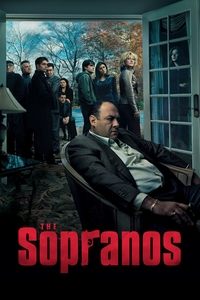
The recap
The Sopranos ran for six seasons on HBO between 1999 and 2007. David Chase wrote and directed the finale, 'Made in America.' It aired June 10, 2007. The final scene placed Tony, Carmela, and AJ at Holsten's Brookdale Confectionery, ordering onion rings while Journey's 'Don't Stop Believin'' played on the jukebox. Meadow parked outside, struggled to parallel park, then ran in. A man at the counter walked toward the bathroom. Tony looked up. The screen cut to black for ten seconds. Then credits.
Audiences thought their cable had failed. Many called HBO. David Chase refused to confirm whether Tony was killed in that moment, and the ambiguity became one of the most-discussed structural choices in prestige TV history.
What actually happens
The structural argument the finale makes is that the question of whether Tony lives or dies is the wrong question. The cut to black operates as the audience's experience of Tony's own consciousness ending mid-bite, mid-conversation, mid-life. Chase has said in subsequent interviews that 'he dies,' but he has also said the answer doesn't matter.
Specific structural clues: throughout the season, Bobby Bacala tells Tony that 'you probably don't even hear it when it happens.' Earlier in the same season, a Members Only jacket-wearing man at the gas station has eyed Tony. At Holsten's, a Members Only jacket-wearing man walks to the bathroom (the Godfather Part I parallel: Michael Corleone retrieved a gun from a bathroom to kill Sollozzo). The orange-cat motif that haunts Paulie's apartment is connected in mafia folklore to imminent death.
Chase's structural commitment was to render the actual sensory experience of being assassinated by someone who has been planning it for weeks. Not a dramatic confrontation. Not a final monologue. Just an interrupted onion-ring order.
What the ending earns
On the TVI rubric, The Sopranos scores 176 (Masterclass tier). The ending is one of the structural reasons. Cognitive Stimulation: 47/50. The finale demands the viewer hold every prior season's foreshadowing simultaneously and reconcile it against a single ten-second cut. Few other prestige-TV endings demand that scale of integration.
Where the ending earns its score: structural commitment to refusing dramatic resolution, formal precision of the Holsten's mise-en-scène (every shot of the diner is composed with point-of-view positioning that places the viewer in Tony's chair), and the willingness to let audience confusion be the actual subject of the work.
Where critics argue it falls short: viewers who wanted closure read the cut-to-black as artistic cowardice rather than artistic commitment. Chase's refusal to confirm the ending one way or the other has been read by some as evasion rather than as the structural argument it actually is.
Frequently asked
Does Tony Soprano die in the finale?
David Chase has stated in interviews that Tony Soprano dies in the final scene. Structurally, the finale is constructed to operate either way: the cut to black is the audience's experience of Tony's consciousness ending mid-sentence. The Members Only man entering the bathroom, the Bobby Bacala line 'you probably don't even hear it when it happens,' and the Godfather Part I parallel all support the death reading. But Chase has also said the question of life-or-death is not what the ending is about.
What is The Sopranos' IQ Score on TV Intelligentsia?
The Sopranos scores 176 out of 200 (Masterclass tier). Cognitive Stimulation: 47/50. Educational Value: 37/50. Craft & Quality: 49/50. The show is widely cited as the founding text of prestige TV.
Why did David Chase choose a cut to black?
Chase has said the structural commitment was to render the actual sensory experience of being assassinated. Not a dramatic confrontation. Not a final monologue. The audience experiences Tony's consciousness ending the way Tony would: mid-bite, mid-sentence, with no time to process what is happening.
Was the song 'Don't Stop Believin'' a clue?
The Journey song is the most-cited musical cue in finale history. Tony chose it from the jukebox tableside. The lyrics 'don't stop' get cut off exactly at the cut to black, which can be read as either the finale's joke or its argument: the universe of Tony's experience stops. Chase has not confirmed the song was a planned clue, but its structural placement is precise.
TV Intelligentsia scores every major series on a published methodology rubric. IQ Score is a content rating, not an intelligence measurement.
See the full The Sopranos score breakdown