Gabriel Badejo on What It Takes to Be Believed
The director of The Sickling talks with Jordan Robinson about filming his own stem cell transplant, his relationship with his father, and how sickle cell disease is misunderstood.
Interview, not a score. Any TVI score for this work follows its general release under the published methodology. Scores are not for sale.
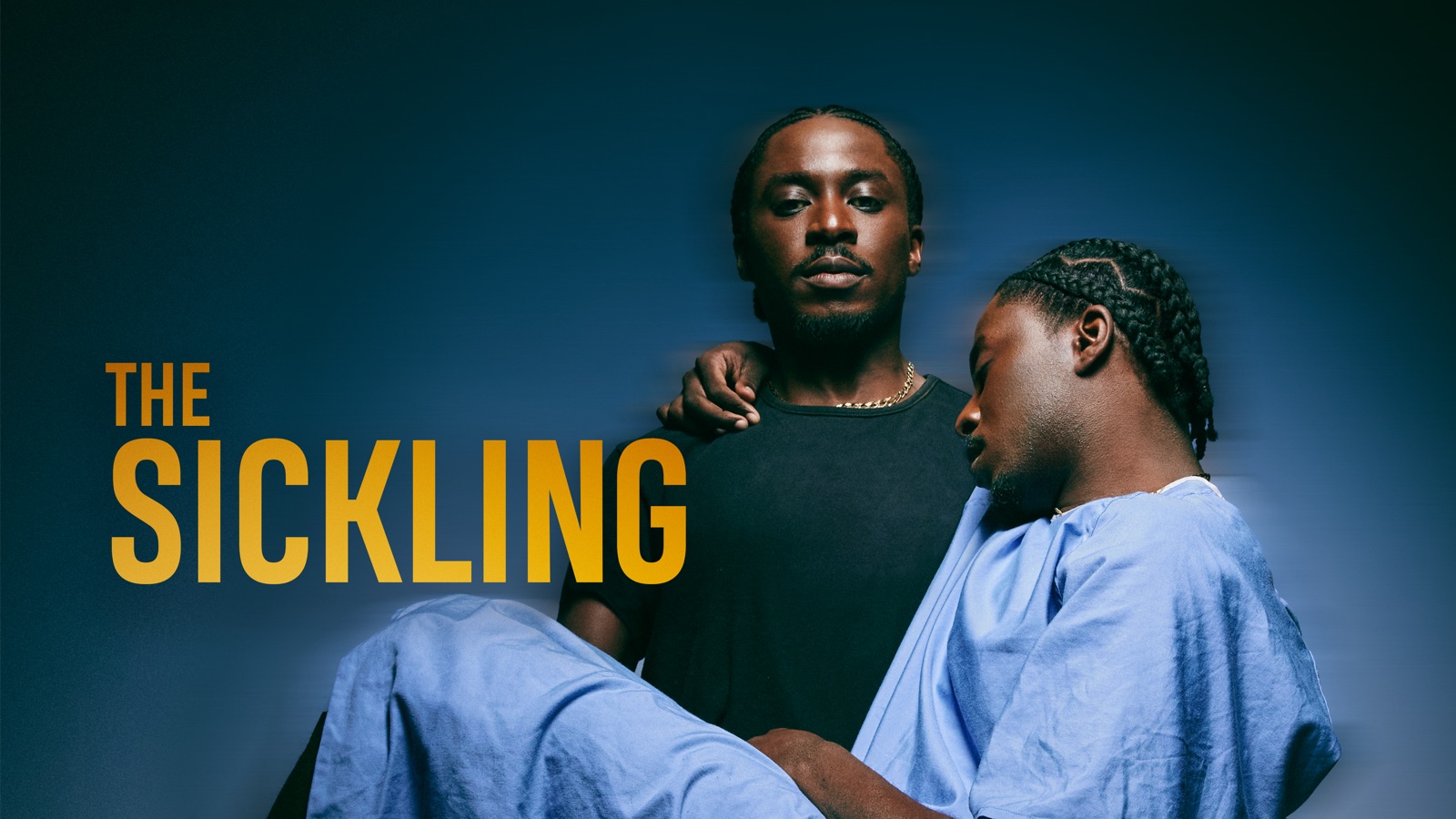
Gabriel Badejo has struggled with the invisibility of sickle cell disease for nearly his entire life. That invisibility has made him wonder whether the way he presents himself affects the care he gets. So he decided to experiment. He has gone to the emergency department in a button-up shirt. He has gone in a hoodie. He has arrived in pain he could still joke through, and in pain that left him crying on the floor.
"None of that really makes a difference," he told me. What mattered was whether the person in front of him knew anything about sickle cell disease.
The Sickling, his first feature documentary, is the larger version of that test. Badejo directed it, produced it, and is its subject. The film follows him through a lifetime of pain crises, an experimental stem cell transplant, and the years of uncertainty that came after. Around his own story it sets the history of the disease and of the people it mostly affects.
"I always wonder, if they know me as a person, would the treatment be different?" he said. "Maybe if I show more of myself, maybe that might change how they look at experiences like mine."
Why he started filming
Early in the film, Badejo says he never saw the point of recording his life, because he did not expect to be around to look back on it. I asked what changed.
There were two moments, he said. The first came in 2018, in a hospital room, during the crisis the film reconstructs through his 911 call. He turned to the friend sitting with him.
"These people can't keep getting away with this," he remembers saying. "If this is how it's going to end for me, I want to die fighting."
He was already working in film. That day was the first time he thought of making a documentary, though for a while it was only an idea. The second moment came at the end of a virtual appointment he took from a film set, when his doctor asked whether he would consider joining a stem cell trial.
He told the doctor he would think about it. He also decided that the treatment needed a record, of what it cost as well as what it promised. "Right away, I just started documenting from that point."
The transparency of triage
I asked what he looks for when he arrives at a hospital in crisis.
"You can kind of tell really right away what kind of experience you're going to have in the hospital, based off how quickly you get through triage," he said. If someone Black is working the desk, he relaxes a little. If not, he expects to explain himself.
Certain questions tell him how the night will go. If someone asks when he got sickle cell, a disease he was born with, he knows it will be long.
His manner does not help him either way. If he laughs or makes a joke to keep his mind off the pain, he is assumed to be coping. If he cries, he is assumed to be performing.
"You're almost damned if you do, damned if you don't."
The impact of his upbringing
In the film, Badejo describes a father who had him run laps and climb stairs through the pain, and a mother who objected. I asked whether that upbringing meant he arrived at hospitals showing less pain than he was in.
Probably, he said. His father wanted him to be strong and not let the disease get him down. As a child he did not understand it. As an adult he credits it with teaching him to adjust his mind to extreme pain. He called it a militaristic way to be raised.
There is something else in it too. "As a man, I'm not really trying to present as a weak person," he said. Crying in a hospital, unable to stand, embarrasses him, and he cannot help it. "I'm just really trying to fight and hold on to my own pride and dignity."
His father gave him strength and stubbornness, he said. His mother gave him comfort, and room to deal with what he was dealing with.
Making the film taught him how much she had been carrying. In an interview for the documentary, he learned that she has never told her own family he has sickle cell. Several of her cousins had the disease, and all of them died. She did not want her mother believing her first child would die too.
"There's so many things that our parents are holding, in terms of taking care of their young, that we just don't know," he said.
Losing his father
Badejo started treatment in May. His father died that November.
"It felt like everything I knew about life and about myself was just unraveling," he said.
Before the transplant, he had asked his father to be part of the documentary, to tell his own story inside his son's. His father refused, and they went back and forth about it. After he died, Badejo had to decide how much of him belonged in the film.
He described signs, in the months afterward, that he took as his father telling him to move forward. That is what let him include more of his father's story than his father had agreed to.
"I just wanted to honor him in the best way I could."
What the history taught him
The film spends real time on the history of the disease, on public health, and on how bias shapes treatment. I asked whether anything he learned making it changed how he experienced his own illness.
Not really, he said. He had lived it. But the more he learned, the less some of it made sense to him.
"It's amazing to me how there could be a solution in arm's reach, and no one is grabbing it."
After the transplant
Near the end of the film, Badejo compares his life to a race: while you are running, adrenaline covers the injuries, and you feel them when you stop. I asked whether that was still true.
It is, he said. He thinks of himself as strong-willed, and during the transplant he found himself close to tears at small things, a comedy on television. Afterward he had his first anxiety attacks. His first crisis came when he was about a year old, and he does not expect to sort through a lifetime of them quickly.
"Your body remembers these kind of things," he said. He is in a better place now. He is also giving himself grace, and not pressure, to have it figured out.
The question he asked me
Toward the end, Badejo asked me something. When he feels dismissed in a hospital, he said, it feels like everybody is in on it, and he cannot tell whom to trust. He wanted to know how medical professionals talk about patients like him when the patient is not in the room.
I told him what I believe: that medicine is a human field, with the best and the worst of that. The pattern recognition that makes clinicians good at solving problems is the same habit that lets us decide who a person is before we know. I have done it. People in hospitals also talk to each other, and an impression can travel. I told him I think it eventually gets checked: somebody speaks up and, I hope, does the right thing for the patient.
Badejo said he always hopes for that too. "But sometimes I feel like that doesn't happen very often," he said.
It has happened for him once. During a week-long admission, he said, the team believed he was addicted to morphine, until a doctor on rounds asked for his name.
"Oh, I know this patient," the doctor said. "He's good."
After that he got the treatment he was used to and went home in three days. On the day he left, an x-ray showed bone death in his shoulder and collarbone, where he had been saying for a week that something was wrong.
What he hopes for from medicine
I asked what he hopes a physician takes from the film and does differently the next time a patient arrives in crisis.
"Urgency," he said.
He has heard of people who waited an hour in an emergency room and died before a doctor saw them. Sickle cell is a disease of the blood, so it can reach every part of the body. A patient who has learned to cope is not a patient who can wait.
"Even if someone has all these great coping mechanisms to help them cope with their pain, that doesn't make this situation any less urgent."
By the time he comes to a hospital, he said, he has tried everything else. "This is the last resort for me to get help, and I'm asking for help. And someone is saying no."
The impact of community
The Sickling is full of people other than its subject: his mother, his partner, his friends, his family in Nigeria. I asked what he wanted an audience to see besides the disease.
He put it as an extension of the button-up shirt story. If showing more of himself did not reach someone, another person in the film might.
"If they can't relate to me, maybe they can relate to my mom," he said. Or to a partner, or a friend. Everyone has those people. If a viewer recognizes one of them, he hopes the rest follows.
Interview conducted by Jordan Robinson, MD, MPH, by video call on November 12, 2026, and edited for length and clarity. The film's publicists arranged and recorded the call, and Jordan Robinson watched The Sickling on a screener they supplied. The film has its international premiere at DOC NYC on Sunday, November 15, 2026, at 5:30 PM Eastern at Village East by Angelika, and screens online in the United States from November 16 to 29.
Follow the field coverage
Occasional dispatches when TVI is in the room: festival guides, interviews, and what we learned. No volume, no noise.