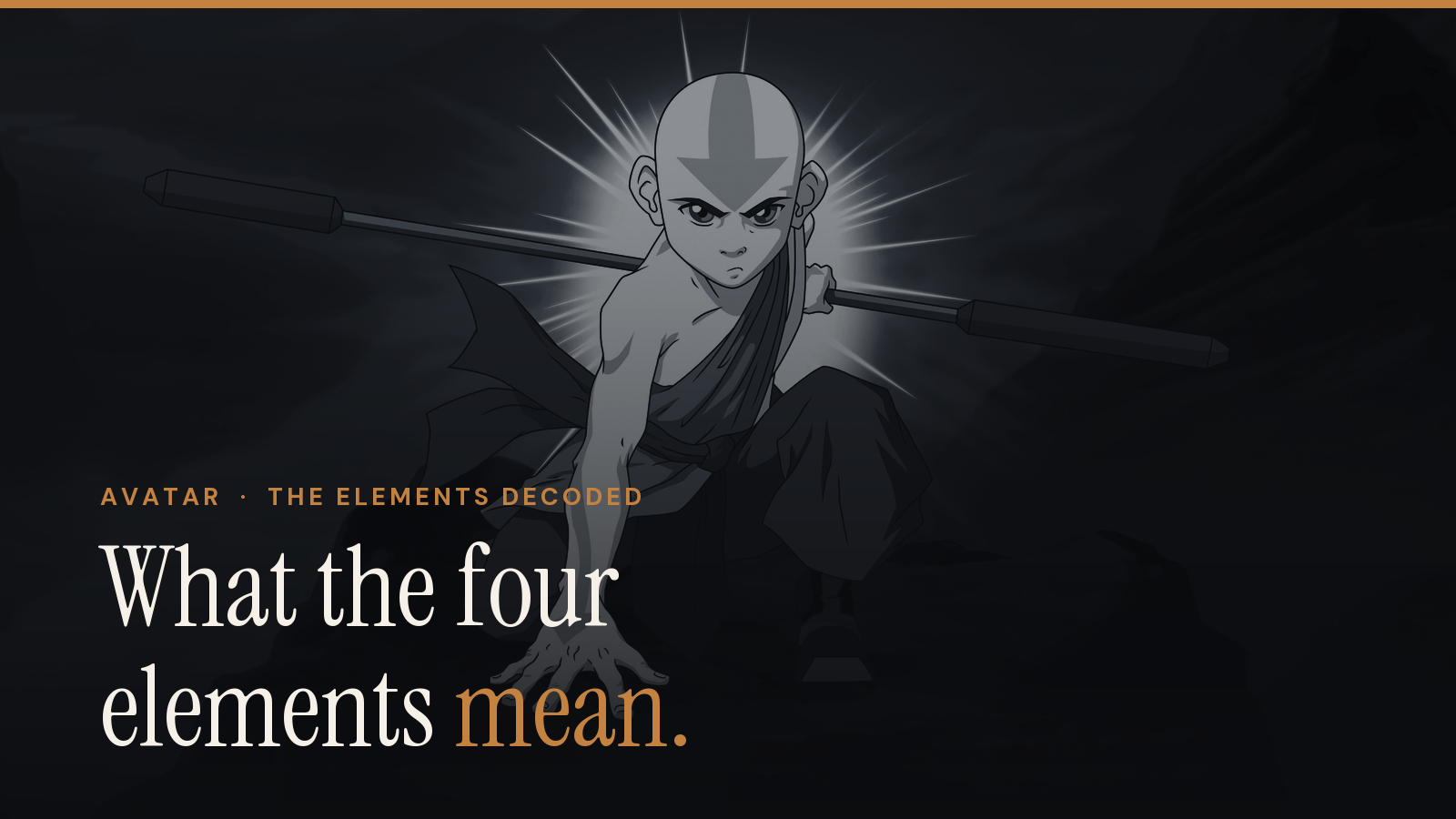
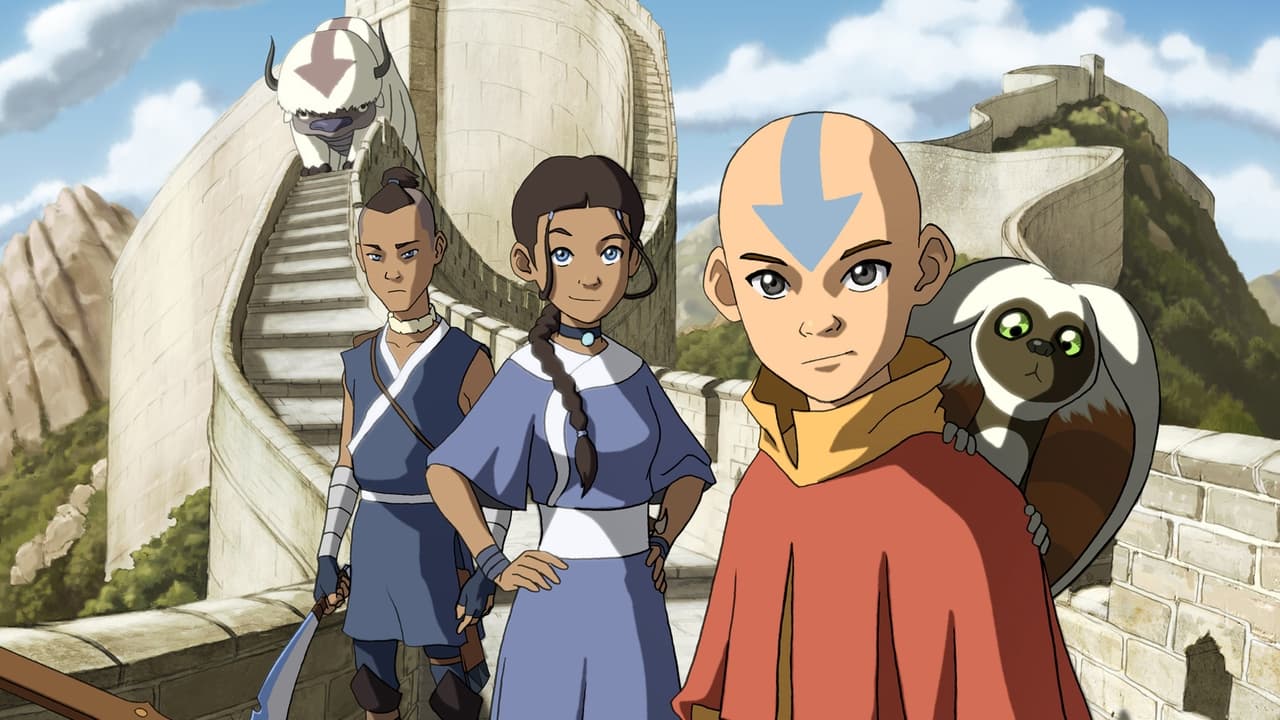
The bending was never only bending
A fantasy system can be a rulebook, or it can be a worldview.
In the weaker version, magic exists to organize combat. Fire beats this. Water answers that. Earth has one tactical function, air another. The system is satisfying because it has rules.
Avatar: The Last Airbender does something more durable. Its rules are not only mechanical. They are symbolic. The four elements do not simply tell us how a character fights. They tell us how a character meets reality.
Earth stands. Water moves. Fire wills. Air releases.
That is why the bending still feels meaningful after the spectacle has become familiar. A child can enjoy the forms as motion, style, color, and combat. An adult can return and realize the show had built an inner grammar underneath the action.
The question was never just who could bend what. The question was whether a person could carry power without being taken over by it.
That is the hidden pressure inside the whole series. Aang is not made whole because he collects four techniques. Zuko is not healed because he becomes better at fire. Katara is not free because she has enough power to punish the man who killed her mother. Iroh is not wise because he knows more than everyone else. Each character has to face the same deeper problem in a different form: what happens when a human capacity becomes distorted by fear, guilt, shame, grief, or inheritance?
The show's metaphysics work because they are never merely decorative. The elements, chakras, reincarnation cycle, Avatar State, lion turtle, dragons, moon, badgermoles, sky bison, and spirit world all point toward the same architecture: power becomes safe only when the self becomes integrated enough to hold it.
That is the map this essay reads.
Power becomes safe only when the self becomes integrated enough to hold it.
Two languages for one map
This piece uses two languages at once.
The first is symbolic: elements, chakras, spirit, reincarnation, the Avatar State, the old vocabulary of body, energy, sequence, and transformation.
The second is developmental: nervous-system safety, emotion, shame, grief, self-authorship, continuing bonds, inherited memory, and adult integration.
The symbolic language gives the experience shape, beauty, ritual, and scale. The developmental language gives it mechanism and restraint. Neither replaces the other. The show works because it lets both forms of knowledge meet.
This is what serious esoteric systems do at their best. They are not escapes from reality. They are languages for the parts of reality ordinary literal speech cannot hold well. They use image, body, rhythm, sequence, and symbol because the inner world is not encountered as a spreadsheet. It is encountered as sensation, dream, memory, fear, desire, grief, breath, and movement.
Science gives structure to what can be measured from the outside. Symbolic systems give structure to what is lived from the inside. Avatar is unusually powerful because it lets those two structures speak to each other.
One honest note on method: the show itself runs the chakra sequence through Aang in Book Two, Episode 19, "The Guru." This essay does something broader. It uses that sequence as a lens on the ensemble, because each stage of the work is dramatized most fully by different characters across the series.
Aang carries the root wound of fear and survival. Katara carries the water-work of emotion, grief, guilt, and release. Zuko carries the fire-work of shame and recovered will. Iroh carries the heart-work of grief, love, and continuing bonds. The Avatar carries the integrating principle that can hold the four in right relation.
That is a reading choice, not a canon claim. The reader does not need to believe chakras are literal anatomy for the structure to matter. Treat them here as symbolic anatomy: a map of fear, guilt, shame, grief, truth, illusion, and attachment that has remained useful because those experiences keep returning in human life.
The elemental map
This is the architecture in miniature. Each element is a power, a chakra lens, a human function, a characteristic wound, a way it distorts, and an integrated form.
| Element | Chakra lens | Function | Wound | Distortion | Integrated form |
|---|---|---|---|---|---|
| Earth | Muladhara · root | Ground, safety, survival, embodiment | Fear | Rigidity, collapse, the inability to remain present | Steadiness |
| Water | Svadhisthana · sacral | Emotion, memory, relation, release | Guilt, grief that cannot move | Flooding, avoidance, revenge | Movement without self-erasure |
| Fire | Manipura · solar plexus | Will, action, vitality, power | Shame | Domination, rage, hollow pride | Life-force under discipline |
| Air | Anahata · heart | Breath, love, grief, spaciousness | Loss, attachment, fear of change | Disappearance, possession, refusal to stay | Love that can remain open |
| Speech, sound | Vishuddha · throat | Truth, voice, self-authorship | Lies | Speaking the inherited script | Alignment |
| Sight, light | Ajna · third eye | Insight, perception, pattern | Illusion | Mistaking distinction for separateness | Interdependence |
| Thought, spirit | Sahasrara · crown | Surrender, ultimate relation, release | Attachment | Possession, refusal of change | Non-possessive love |
| The Fifth | Akasha · aether · Self | The field that holds the parts | Fragmentation | Possession by one element or function | Integration |
The four elements are the visible grammar. The upper gates clarify the inner obstructions. The Fifth is not another technique. It is the organizing field in which the parts can become whole. The show calls that field the Avatar.

Earth, Muladhara, and the body's right to remain
Aang reaches the Southern Air Temple expecting home.
The place is quiet in the wrong way. The colors are still warm. The architecture is still beautiful. The air still moves through the high stone spaces. That is part of why the scene hurts. The world has not become visually ugly. It has become absent.
Then he sees Monk Gyatso.
For a child watching, the shock is immediate because the show has trained us to associate Aang with motion: the air scooter, the glider, the laugh, the dodge, the grin. At the Southern Air Temple, he stops. The boy who survives by moving has encountered something movement cannot solve.
That is the root.
In the chakra sequence, Muladhara is the root-foundation, the seat of survival, safety, and ground. Fear lives there. The first work of any developmental or spiritual practice is not transcendence. It is stabilization. No higher work holds if the body does not believe it is safe enough to remain present.
In grounded language, this is nervous-system safety. The body's first question is not meaning, purpose, or enlightenment. The body's first question is whether it is safe.
Aang's root has been violated catastrophically. He did not simply lose loved ones. He lost the whole infrastructure that told him who he was: temples, monks, rituals, games, food, airbending forms, laughter, and a living culture able to recognize him. He wakes as the last body of his kind.
His first task is to find a way to be in the world without that safety. Not by replacing it. Not by pretending it did not matter. By learning to carry fear without being governed by it.
This is why Aang's avoidance is not only immaturity. It is trauma logic. He runs because motion keeps him ahead of the loss. He plays because play is one of the few ways his body still knows how to live. He disappears into lightness because ground has become unbearable.
Earth is the element he resists because earth asks him to stop. Toph's teaching works because it is not temperamentally natural to him. She does not teach Aang to float more beautifully. She teaches him to stand, meet force, stop negotiating with the blow, and answer it.
That is earth as medicine. Aang does not need earth because earth is superior to air. He needs earth because air without ground becomes disappearance.
The show does not teach that healing means the frightening thing never happened. It teaches something more honest: safety can be rebuilt in the body after the frightening thing happened.
A child does not need the phrase "root wound" to receive the image. A child understands: Aang lost his home. Years later, when the viewer knows something about homes that cannot be returned to, the image opens again.
•••
Water, Svadhisthana, and feeling that must move
Water in Avatar is never just a combat style. It is the show's language for memory, adaptation, healing, relation, and emotion that refuses to remain fixed.
The moon pulls the tide. The healer pulls water through the body. Katara pulls grief through rage. Aang learns that motion can be more than escape. It can also be response.
In the chakra sequence, Svadhisthana is the water center: pleasure, emotion, generativity, and the felt relationship to one's own inner life. In "The Guru," it is blocked by guilt. That matters for Aang. He does not only grieve the Air Nomads. He believes he failed them. He ran away, froze, vanished, and woke to a century of suffering.
The child did not cause the war. But guilt does not always wait for accuracy before it takes up residence in the body. That is the cruelty of guilt. It can attach to a child's fantasy of control. If I caused it, then maybe the world is not as terrifyingly random as it feels. If it was my fault, then maybe I can repair it by becoming perfect.
Water asks for a different movement. Not denial. Not self-punishment. Movement.
Katara becomes the show's fullest water image in "The Southern Raiders." She stands in the rain with Yon Rha in front of her. Revenge is available. The water rises.
Then she walks away.
That scene is often described as forgiveness. The word is only partly useful. Too often, forgiveness is sentimentalized into absolution. The show is more precise. Katara does not absolve the soldier. She does not discover he is secretly worthy of peace. She does not hug him. She does not decide the harm no longer matters. She does not pretend her mother is less dead.
What she releases is not the past. What she releases is the future the wound was trying to write for her.
A severe wound can organize time around itself. One day I will find him. One day I will make him pay. One day this feeling will finally have somewhere to go. That imagined future feels like power, but it keeps the offender at the center of the survivor's life.
Katara's walking away is the intervention. She refuses to let revenge author the next version of herself.
That is why the scene remains so adult on rewatch. Sometimes the person who hurt you is not large enough to carry the meaning of what happened. Sometimes revenge would not restore scale. It would only bind you permanently to a smaller object than your grief deserves.
Water teaches movement. Aang has to let guilt move without becoming self-erasure. Katara has to let grief move without becoming revenge. Neither is asked to pretend the wound did not happen. The wound moves. The self remains.
•••
Fire, Manipura, and will recovered from shame
Zuko's scar tells the story before the flashback does.
A child was marked by the person who was supposed to protect him. He says "honor" until the word stops sounding like a virtue and starts sounding like a wound trying to speak.
The first time through, a child may see Zuko as the villain who will not stop chasing the hero. Later, the chase looks different. Zuko is not chasing Aang. Zuko is chasing permission to exist.
That is the solar plexus.
In "The Guru," Pathik names the third chakra as the fire chakra. It deals with willpower and is blocked by shame. The show gives the key away. Fire is will, action, appetite, assertion, and power. Integrated fire gives life. Distorted fire dominates. Shame blocks fire because shame colonizes will at the source.
Guilt says: I did something wrong. Shame says: I am wrong.
That second sentence is Zuko's prison.
Ozai gives him an impossible condition for love: capture the Avatar, restore your honor, come home. This is how abusive systems work. They make belonging contingent on an impossible task, then call the child's desperation loyalty.
Zuko's recovery is not a clean redemption event. It happens in stages because shame rarely releases the self all at once. He almost changes, then betrays the change. He gets what he thought he wanted and discovers the reward is hollow. He returns home and finds that home has not returned him to himself. By the time he confronts Ozai, the speech is not a sudden reversal. It is authorship returning.
Recovery from shame is not pride. Pride can remain organized around the wound. Recovery is the capacity to say who you are without borrowing the sentence from the person who hurt you.
This is why lightning redirection is the perfect teaching. Iroh teaches Zuko to receive energy meant to destroy him, guide it through the body, and release it without letting it pass through the heart. The technique is the metaphor.
What comes at you does not have to become you. That is shame work in the language of fire.
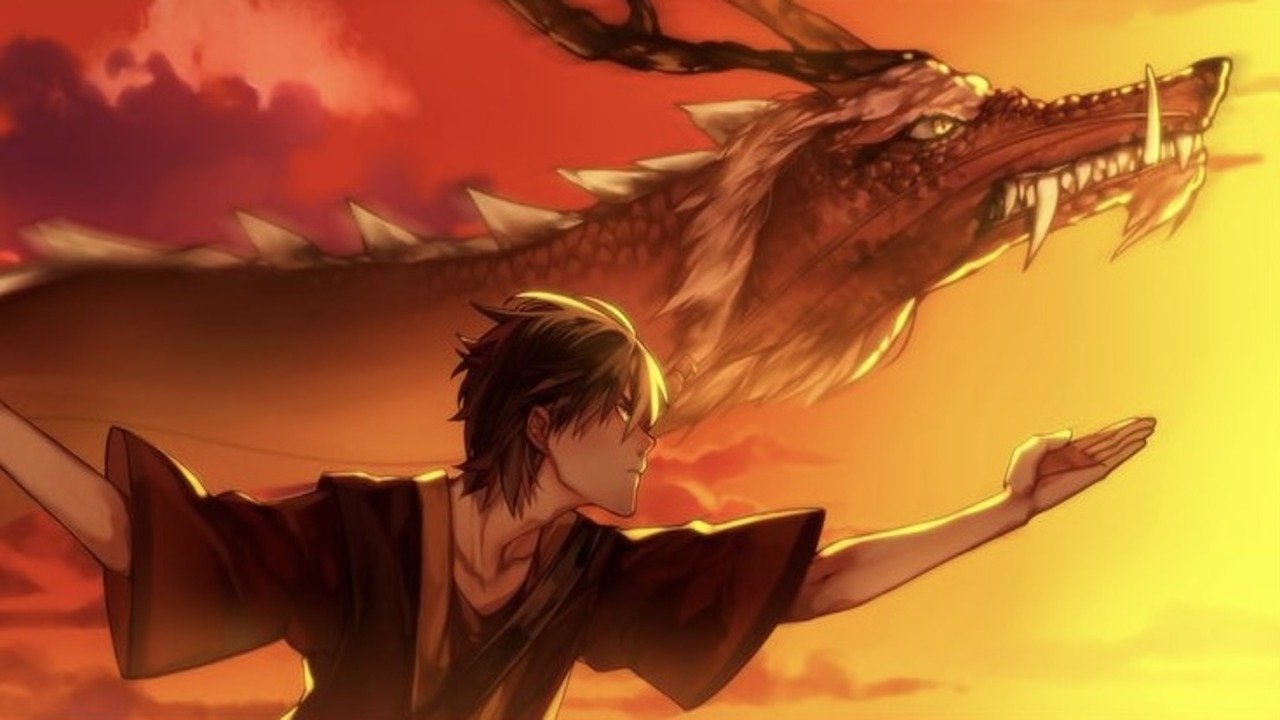
It is also why "The Firebending Masters" matters so much. Zuko and Aang travel back past the Fire Nation's imperial distortion to the dragons and the Sun Warriors. They rediscover fire before conquest narrowed it into rage. Fire is not hatred. Fire is not domination. Fire is not the father's wound. Fire is life, breath, warmth, drive, presence, and disciplined vitality.
Zuko does not heal by extinguishing fire. He heals by recovering fire from shame. That is the difference between suppression and integration.
•••
What comes at you does not have to become you.
Air, Anahata, and love after loss
Iroh climbs a hill with a picnic basket and a portrait.
It is Lu Ten's birthday.
He sings "Leaves from the Vine" and breaks before the song can hold him.
Some scenes become harder with age because the viewer catches up to them. This is one.
In the chakra sequence, Anahata is the heart, the bridge between the lower centers and the upper ones. It is the place where body and spirit, survival and meaning, private wound and love beyond the self meet. Air is the right element because grief is a breathing problem before it is an idea.
Loss changes the rhythm of the body. The heart keeps reaching toward a world that still contains the person who is gone. The work is not to cut the bond. The work is to let love continue without turning it into possession.
Modern grief language calls this continuing bonds. The dead do not vanish from the self. The relationship changes form. It does not become nothing.
Iroh does not get over Lu Ten. He prepares a picnic.
The restraint is the power. The show does not explain the grief into manageability. It lets ritual carry it: food, portrait, song, place, tears. That is what continuing love looks like when it is placed in the body instead of reduced to a concept.
The scene also changes Iroh retroactively. His patience with Zuko is not generic kindness. It is grief transmuted into care. He could not save his own son. He can stay with this wounded nephew. That does not replace Lu Ten. It honors him.
Air here is not escape. It is breath spacious enough to let love continue after the body is gone.
Aang's air-work is different but related. His native element is movement, release, nonattachment, humor, and spiritual openness. But his distortion is also air-shaped. He can vanish, evade, float away, slip out of the unbearable thing before it can touch him.
That is why Guru Pathik's final instruction wounds him so deeply. He is told to release earthly attachment, and the person he cannot release is Katara. The show could have made renunciation the answer. It does not. Aang's final wholeness does not require him to abandon love. It requires him to carry love without letting fear of loss govern the whole self.
Attachment becomes distortion when it tries to possess the beloved, freeze the world, or make growth impossible. Love becomes mature when it can remain open without demanding control.
Iroh shows love after death. Aang shows love under the threat of loss. Both are heart-work. Both are air-work. Both ask the same question: can love remain love when it cannot keep the world from changing?
•••
The upper gates: truth, illusion, and attachment
The first four chakras are easier to see because they map cleanly onto bodies, emotions, wounds, and relationships. The upper gates are subtler. They are where the show's metaphysics becomes explicitly philosophical.
Vishuddha, the throat or sound chakra, is blocked by lies.
In developmental terms, this is the problem of self-betrayal. A person can survive for a long time by speaking the story they were given instead of the one they know to be true. Zuko does this for most of the series. The Fire Nation does it at the scale of empire. Aang does it whenever he hides from the full implication of being the last airbender.
Truth is not mere accuracy. Truth is alignment between inner knowledge and outer speech. That is why Zuko's confrontation with Ozai has the force of an energetic release. He does not win the fight physically. He wins the authorship of his own voice. He says what has become true in him, and the lie that structured his life finally loses its throne.
Ajna, the third-eye or light chakra, is blocked by illusion.
Pathik names the illusion of separation: the idea that the four nations are entirely separate, or that any part of life can be understood in isolation from the whole. This is the metaphysical heart of the series. The war persists because the world has mistaken distinction for separateness. Nation, element, tribe, family, and self become hardened borders instead of living differences within one field.
The show does not abolish difference. It honors difference. The Water Tribes are not the Earth Kingdom. The Fire Nation is not the Air Nomads. The point is not sameness. The point is interdependence. Illusion breaks when difference stops requiring domination.
Sahasrara, the crown or thought chakra, is blocked by earthly attachment.
This is the most difficult gate because it is the easiest to misread. A shallow reading says Aang must stop loving Katara. A better reading says Aang must stop confusing love with possession, fear, or refusal of change.
The finale proves this. Aang does not become whole by abandoning Katara. He also does not become whole by abandoning his refusal to kill. His integration is not achieved by cutting away his loves, his ethics, or his grief. It is achieved by holding them without letting any one of them seize the whole field.
That is the show's deepest disagreement with simple power fantasy. Power fantasy says: become strong enough to impose the answer. Avatar says: become whole enough that power no longer has to possess you.
Become whole enough that power no longer has to possess you.
The Fifth, Akasha, and the Avatar State
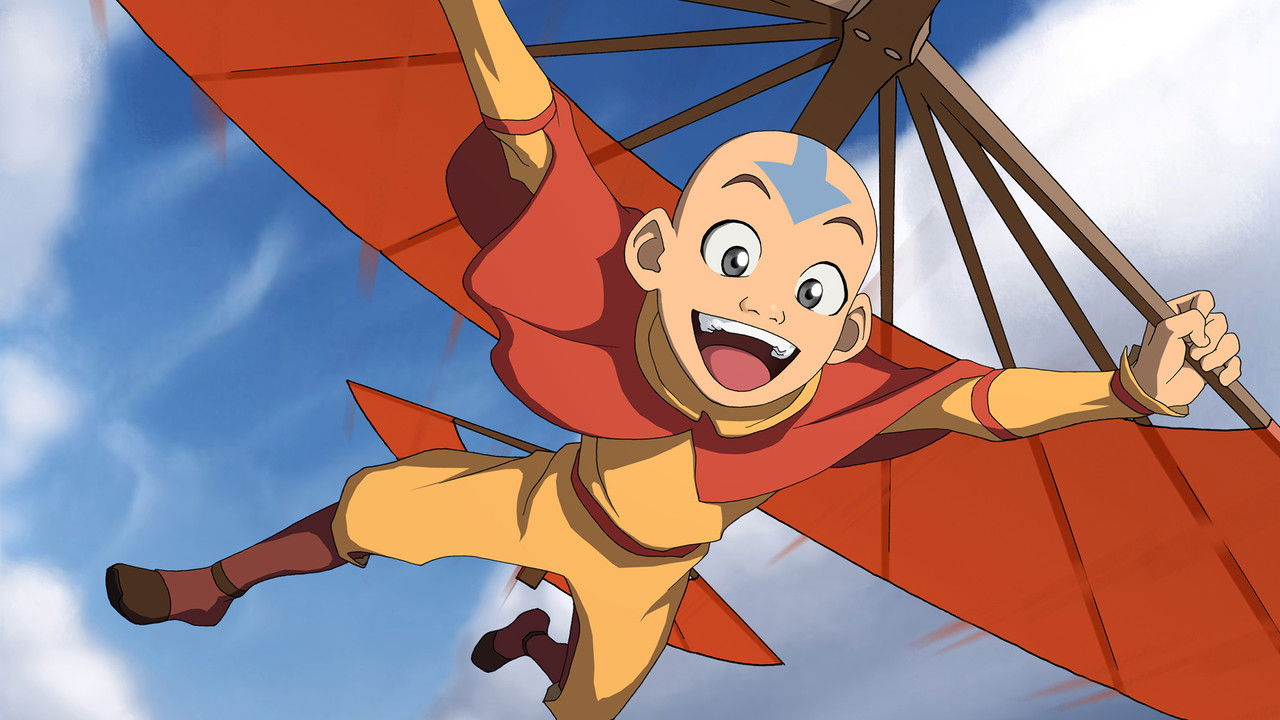
The Avatar State looks like power when you are ten. Eyes lit. Arrow burning. Every past life standing behind one body.
Later, it looks more complicated. It is power, but it is also inheritance, danger, memory, permeability, and the burden of being opened to more than one lifetime can hold.
Then the finale gives another image: Aang facing Ozai, refusing the clean solution everyone else has accepted. The lion turtle. The hand to the forehead. Energybending. The Avatar State not as domination, but as integration disciplined by conscience.
That is the fifth.
In the Hindu Pancha Mahabhuta, the fifth element is akasha: space, sky, ether, the field in which the other elements arise. In Western Hermetic language, the fifth is aether, spirit, quintessence, the integrating principle that turns four directions into a world. In Jungian psychology, the closest analogue is the Self: the organizing center that can hold thinking, feeling, sensation, and intuition without being reduced to any one function.
These systems are not identical, and the differences matter. But they preserve a similar structural intuition: wholeness is not domination by one element, one function, or one stance toward the world. Wholeness is the field that can hold multiplicity without collapse.
One clarification keeps the syncretism honest rather than loose. In the traditional chakra system, akasha is itself the element of a single center, Vishuddha, the throat, whose sensory quality is sound. That is why the show codes that gate as the chakra of truth and voice. This essay also uses akasha in its older, larger sense, the one the Pancha Mahabhuta gives it: not one center among the others, but the subtle ground from which the other four elements arise. The two readings are not a contradiction. They are the same word naming a part and naming the whole, and that doubleness is exactly the relationship the Avatar embodies, a single life that is also the field the elements move through.
Every Avatar is born into one element. Aang is air. Roku was fire. Kyoshi was earth. Kuruk was water. The cycle continues. The native element is a gift, not a finished self. Each Avatar must master what does not come naturally until no single element runs the whole life.
You are born with an advantage: temperament, gift, stance, instinct, the thing that comes easily. But your gift can become your prison if it is the only way you know how to meet reality. The Avatar's task is not to become less air, less fire, less earth, or less water. The task is to let the native element mature enough to hold the others.
The reincarnation cycle gives that lesson cosmic scale. The personal Avatar dies. The role continues. What survives between Avatars is not the personality of the previous child. It is the integrating function: the obligation to restore balance in whatever historical moment receives the next body. The pattern persists. The instances do not.
The past Avatars matter because no one begins from nothing. Aang can consult his previous lives. We consult ours differently: history, culture, family, inherited trauma, ancestral memory, old stories, and the private record of everything we have survived. The past can guide or possess. The task is to carry it without being replaced by it.
That is why the Avatar State feels different on rewatch. At ten, it is the moment Aang becomes strong. Later, it is the moment he becomes permeable to history. Later still, it is the moment the viewer asks what inheritances move through them, and whether they are integrated enough to carry those inheritances without being ruled by them.
•••
The teacher is the opposite
The first benders did not invent bending. They learned by watching the world. Airbenders learned from sky bison. Waterbenders learned from the moon. Earthbenders learned from badgermoles. Firebenders learned from dragons.
Look closely, and a pattern appears. The teacher is not the easy example. The teacher is the limit case.
Airbending is learned from sky bison, the heaviest creatures in the sky. You do not learn lightness from something that was never heavy. You learn it from the creature with the most weight to overcome.
Earthbending is learned from blind animals that know the ground because ordinary sight is unavailable. Toph is the human form of the same teaching. She does not master earth despite blindness. She masters earth by knowing the ground from the inside.
Waterbending is learned from the moon, the distant body that moves the oceans without touching them.
Firebending is learned from dragons, which matters because the Fire Nation spent a century forgetting what dragons knew. Fire is life before it is destruction. Warmth before conquest. Energy before rage.
Put the four together and the show is making a claim about mastery. You do not learn the essence of a thing from the comfortable middle. You learn it at the boundary, where the quality is hardest to achieve.
The heaviest animal teaches flight. The blind animal teaches sight. The distant body teaches intimate movement. The destroyer's element is recovered from life.
That is not only clever mythology. It is real pedagogy. A concept is understood most deeply where it strains, where it inverts, where it has to overcome the most to become itself.
This is also why Aang's task is harder than four times any single bender's. He has to learn what he is not. Earth asks the evasive boy to stop and confront. Fire asks the gentlest child in the world to wield committed force without becoming cruel. Water asks the detached one to let himself be moved.
The Avatar masters the elements by going to the edge of what he is and learning from what he is not.
Fire forgot itself
The political world of Avatar is also a psyche. The Fire Nation has dominated the world for a hundred years. Symbolically, will has taken over. Action has taken over. Expansion has taken over. Fire, in its shadow form, has mistaken vitality for conquest and power for domination.
This is why it matters that the person who can save the world is the last airbender. Air is breath. Air is movement. Air is mind. Air is lightness. Air is the capacity to see from above, to move around the fixed obstacle, to refuse the terms of force. A world ruled by distorted fire needs the return of air, not because air can overpower fire, but because air remembers a different relationship to power.
The Fire Nation did not merely kill a people. It nearly erased a mode of being from the world. The Air Nomads represent spiritual discipline, play, contemplation, and a kind of intelligence that changes reality without gripping it. When they are gone, the world does not only lose a culture. It loses balance in consciousness itself.
That is why Aang's innocence is not incidental. His playfulness is not just there to make him child-friendly. It is part of what the world needs preserved. If the war forces Aang to become only a weapon, then the Fire Nation has won even if Ozai loses.
This is the metaphysical pressure under the finale. The world tells Aang that maturity means killing. The past Avatars tell him that duty may require it. The logic of war tells him the clean solution is violence. Aang's task is harder: to save the world without letting the world's distortion become his own.
Fire forgot itself. Aang's refusal helps the world remember.
The dragons and the weighing of the heart
Fire remembers itself in one specific episode: The Firebending Masters, in Book Three. Zuko has lost his bending, because rage was its fuel and he has put the rage down. He and Aang travel to the ruins of the Sun Warriors, the civilization where firebending began, to look for the original source. What they find is not a technique. It is a test.
Look at the structure of the scene. Two seekers climb to a summit and present themselves to two masters, Ran and Shaw, dragons, one red and one blue, who circle the pair and judge what they find there. Worthy, and they will be taught. Unworthy, and they will not leave the mountain. Nothing about the test measures strength. Aang and Zuko survive it by arriving honestly, holding a form they learned from the statues of the dead, admitting openly what neither of them knows.
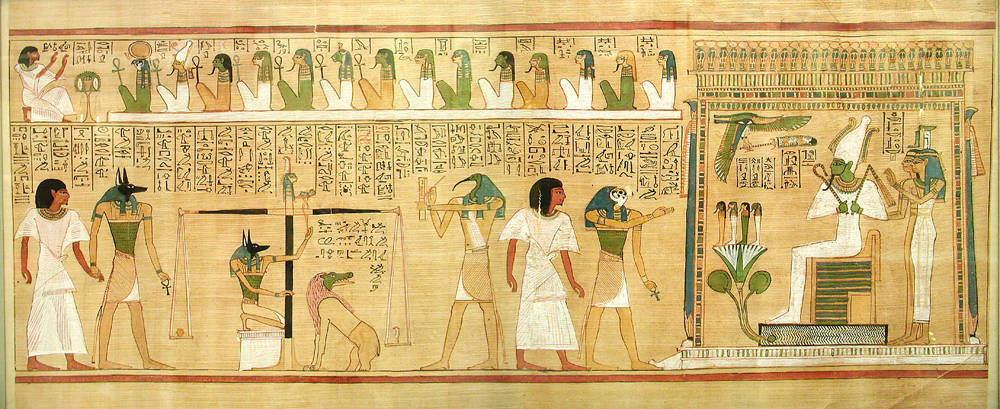
This is one of the oldest scene shapes in recorded religion. In the Egyptian judgment of the dead, the heart of the deceased is weighed against the feather of Ma'at, the principle of truth. Thoth records the result. A heart heavier than the feather, weighed down by what it carries falsely, is devoured. The test was never whether you were powerful. It was whether your heart was light enough to be true. Later esoteric traditions redrew the same scene for the living: twin guardians flanking a set of scales, one red and one white, the opposites that must be integrated before anyone reaches the center, and between them a flame that does not punish but refines.
Whether or not the show's writers were quoting any single source, the pattern they landed on is exact. Two dragons, red and blue. A judgment of worth that reads the heart rather than the muscle. And then the teaching itself: the masters breathe a spiraling vortex of many-colored fire around the two of them, and what it communicates is not fear. Fire is not rage. Fire is life, the sun inside the body, energy that can warm or illuminate or destroy depending entirely on the heart that carries it. Zuko's bending returns in that moment because its source has changed.
The episode plants one more figure on that mountain, and he is the argument in miniature. Iroh faced the masters before them, the last outsider judged worthy, and then told the world he had slain the final dragon so that no one would ever hunt them. Consider what that lie is. The most decorated general of the most violent nation gave up the glory of the kill to protect the thing that had judged his heart and found it light. Iroh is what fire looks like when it is fueled by love instead of rage, and the show lets you meet the proof before it ever explains the principle: tea, patience, songs, and a will that never once needs anger to burn.
The show gives its most dangerous element the world's oldest entrance exam, and the exam asks the question every tradition that used this scene has asked. Not are you strong enough to hold power. Is your heart light enough to be trusted with it.
The spiral, not the pendulum
Balance is another word the show rescues from simplification. Balance does not mean stillness. It does not mean neutrality. It does not mean every force cancels every other force until nothing moves.
Real balance is living coherence under motion. A body is balanced while walking because it is constantly making tiny corrections. A culture is balanced not because nothing changes, but because it can absorb change without losing form. A person is balanced not because they have no fear, grief, anger, desire, or power, but because those forces can move without taking over the whole life.
The show understands this. Its balance is closer to a helix than a statue. It holds form while moving. The Avatar cycle returns through air, water, earth, and fire, but each return occurs in a different body, a different historical moment, a different crisis. The pattern persists by changing.
That is why the cycle is not a circle trapped in repetition. It is a spiral.
Aang does not return to childish innocence. He returns to mercy after responsibility. Zuko does not return to fire as rage. He returns to fire as life. Katara does not return to grief as identity. She returns to grief as love that keeps moving. Toph does not return to isolation as strength. She returns to relationship without losing force. Iroh does not return to the son he lost. He returns to love after loss has changed form.
A pendulum swings between opposites. Avatar asks for something harder: a return at a higher level. The old part comes back with more consciousness inside it. That is integration.
The lion turtle and the principle beneath bending
The lion turtle appears late, and on a purely mechanical level it can feel convenient. Symbolically, it is one of the most important images in the series.
The lion turtle belongs to a layer beneath the bending system. It is older than the four nations, older than the political structure, older than the war. It speaks from before the world was divided into specialized powers. It gives Aang not a stronger element, but access to the principle beneath elemental form.
That matters. Aang's problem cannot be solved by becoming the best firebender, waterbender, earthbender, or airbender. Ozai's problem is not that he has the wrong element. It is that power has been severed from conscience. The answer has to come from below the elements, from the place where energy and being have not yet split into style.
Energybending is frightening because it is intimate. It does not strike from outside. It touches the organizing force of the person. Aang risks being overtaken because this is not violence at a distance. It is contact with essence.
That is why the sequence matters. Aang does not avoid power. He reaches beneath it and uses a deeper one with greater restraint. The finale belongs in this metaphysical reading because Aang does not defeat distorted fire by becoming a more righteous version of domination. He goes under the entire economy of domination and acts at the level of energy itself. He does not answer conquest with conquest. He answers distortion with reordering.

What the image was carrying
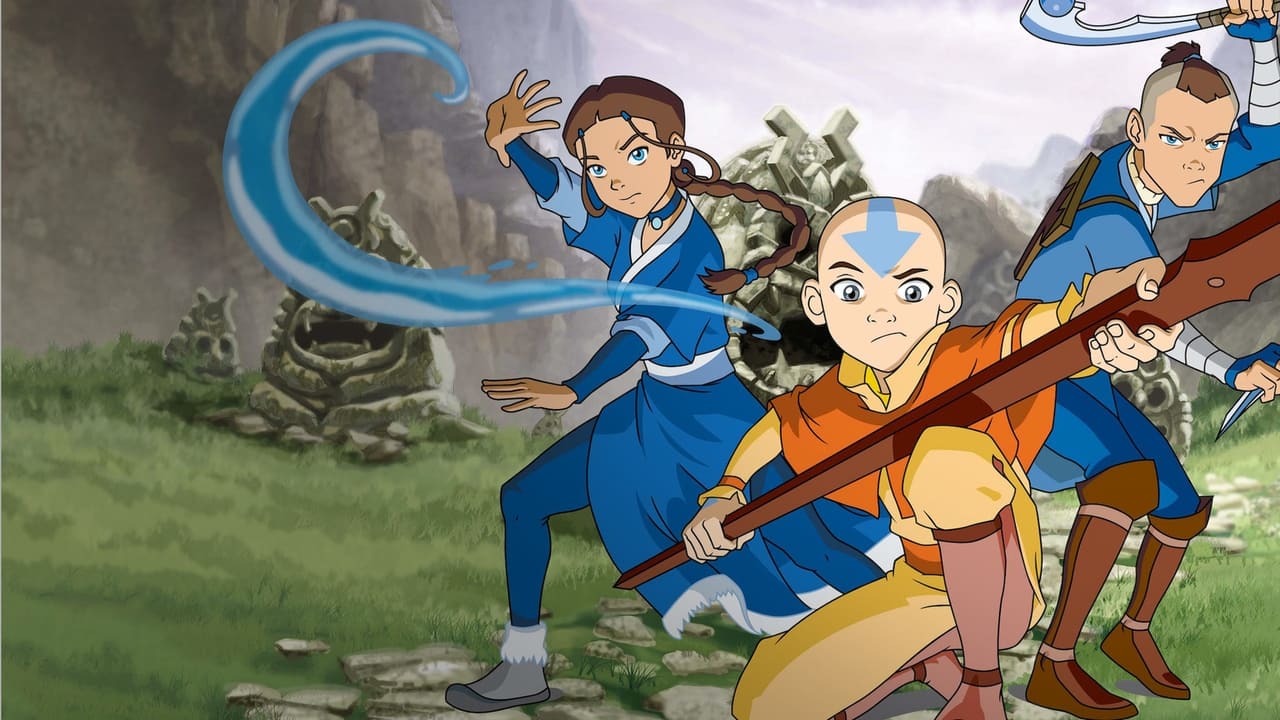
The show builds a symbolic image system around grief, shame, inheritance, and moral repair.
When life becomes unsafe, it returns to Aang at the Southern Air Temple. When grief becomes morally complicated, it returns to Katara in the rain. When shame has to be unwound from family expectation, it returns to Zuko. When someone dies and the relationship does not, it returns to Iroh. When inheritance becomes too large for one body to hold, it returns to the Avatar State.
That is not sentimental attachment to childhood. It is symbolic architecture. The series returns to a small set of durable images and lets their meaning deepen as the characters change.
Early in the series, the Avatar State is beautiful. Later, it is terrifying. Later still, it becomes recognizable as inheritance. At first, Zuko's scar signals villainy. Later, it means wound. Later still, it becomes the sentence a child was given about his own worth. At first, Iroh is gentle. Later, he is grieving. Later still, he is what grief can become when it does not harden into bitterness.
This is one of the deepest formal functions of a children's classic: introduce an image early, deepen its meaning across the arc, and return to it when the story needs it. Then it waits inside the structure.
What remains outside this essay
Two pieces of the show's metaphysical architecture deserve their own treatment and are only adjacent to this reading.
The first is the Spirit World. It is not merely a second location. It is the show's non-material domain: the place where emotion, ecology, memory, imbalance, and moral consequence become visible.
The second is chi-blocking. It implies a parallel energetic anatomy beneath bending itself. It is not the possession of an element, but the interruption of flow.
Those are related systems, but they are not necessary to the argument here. The foundation is simpler: Avatar turns power into a language of inner development.


Closing
The four elements are ways a person meets the world.
Earth stands. Water moves. Fire wills. Air releases.
Each becomes dangerous when it mistakes itself for the whole. Earth without movement hardens. Water without form floods. Fire without conscience consumes. Air without ground disappears.
The Avatar's task is to hold them in right relation: to stand, move, will, and release without letting any one stance become the self.
That is why the title still matters. The show calls Aang the Avatar, but the deeper claim is not only about Aang. It is about what a person becomes when fear, guilt, shame, grief, truth, illusion, attachment, power, memory, and inheritance can move through one life without ruling it.
Children do not need that vocabulary to receive the structure. They receive it as color, music, friendship, loss, jokes, battles, tea, scars, moonlight, dragons, and blue fire around a boy who is trying not to become a weapon.
They return years later and find that the fantasy had been carrying a map. That is why the show lasts. Not because the bending was cool, though it was. Because the bending was never only bending. It was the body learning how to carry the soul.
Sources and traditions referenced
This essay draws on several symbolic and interpretive traditions without treating them as identical.
Avatar canon: Book Two, Episode 19, "The Guru"; the seven chakra blockages named by Guru Pathik; the Avatar reincarnation cycle; the first-bender traditions of sky bison, moon, badgermoles, and dragons; "The Firebending Masters"; "The Southern Raiders"; "The Tales of Ba Sing Se"; the lion turtle and energybending in "Sozin's Comet."
Chakra terminology: Muladhara, root, earth; Svadhisthana, sacral, water; Manipura, solar plexus, fire; Anahata, heart, air; Vishuddha, throat, sound; Ajna, third eye, light; Sahasrara, crown, thought.
Elemental traditions: the Pancha Mahabhuta and akasha; the Western esoteric and Hermetic language of aether, spirit, and quintessence.
Depth psychology: the Jungian language of the Self as an integrating center capable of holding multiple psychic functions without being reduced to one.
Grief theory: continuing-bonds theory, especially the idea that healthy grief does not require severing the relationship with the dead, but transforming its form.
Two free guides built on the same lens, plus the method behind the catalog.
Free guideThe Substance ListTwenty-four films and shows, grouped by the formal and cultural value the score cannot capture. Free guideKinds of MindHow fiction imagines intelligence, read across twenty-one characters. EditorialAvatar: The Last Airbender, reviewedThe flagship review this deep-dive companions. MethodologyHow the TVI methodology worksThree weighted dimensions. One published rubric. The trust layer behind the catalog.About the author
About TV Intelligentsia. TV Intelligentsia is the credibility layer for what to watch, built on a public methodology grounded in cognitive science, developmental psychology, and media-effects research. This essay is the companion to our flagship review of Avatar: The Last Airbender, TVI Kids Essential #2. Editorial scores are not for sale.
Series: Avatar: The Last Airbender (2005 to 2008), created by Michael Dante DiMartino and Bryan Konietzko. Nickelodeon Animation Studio. Companion piece to the TVI Kids Essential #2 flagship at /reviews/avatar-last-airbender/. Published at tvintelligentsia.com/reviews/avatar-elements-decoded.