The Costumes Narrative in Marie Antoinette
Becca Meshinsky on how Milena Canonero's costumes write a second script beneath the spoken one, and what a teenage queen wears while she is being built, rebuilt, and undone.
Contains spoilers, including the ending.

Becca Meshinsky reads Sofia Coppola's Marie Antoinette through Milena Canonero's costume design, which she describes as a second script running beneath the spoken one. The arc has four movements: a fourteen-year-old stripped of her Austrian clothing at the French border and rebuilt in powder-blue court dress, an escalation into feathers, pastels and towers of cake that reads as teenage rebellion inside the rules, a quiet retreat into natural fibers at the Petit Trianon, and a final surrender with no grand gown at all.
Sofia Coppola's Marie Antoinette is a film that fills the screen with incredible detailing from its opening frame. A film with a somewhat simple storyline that almost leaves you to question the point of a film that never reveals the dramatic moment in history we are all familiar with. But this film isn't another take on a history lesson. It's a dive into the interior life of a teenage girl thrown into a role she never asked for. Through fabric and color as through dialogue, costume designer Milena Canonero builds a second script beneath the spoken one. A language of silhouette, palette, and texture that tells us what Marie is feeling and expressing without words.
Stripped and Rebuilt
The clearest statement of this language comes early, at the French border, where Marie is literally stripped of her Austrian clothing and forced into the structured gowns of Versailles. It plays like a makeover scene but it is humiliating rather than empowering.
Upon arrival we see her hair worn loose, tied with a small, girlish bow. Soft colors, fabric that droops and moves with her body, no gloves, and youthful ruffles. This reads as freedom of a girl still capable of playfulness with excitement in her heart.
Her body, the scene makes clear, no longer belongs to her but to the court.
Exiting the tent her face is now powdery white, her hair pulled into a tight architectural style beneath a sharp hat piece to finish, her neck cinched with a precisely tied bow, and her gown is structured to accentuate a womanly figure that isn't fully hers yet. Sleek gloves complete the transformation. The powdery blue of the ensemble glows against the landscape, beautiful, but also cold, and isolating.
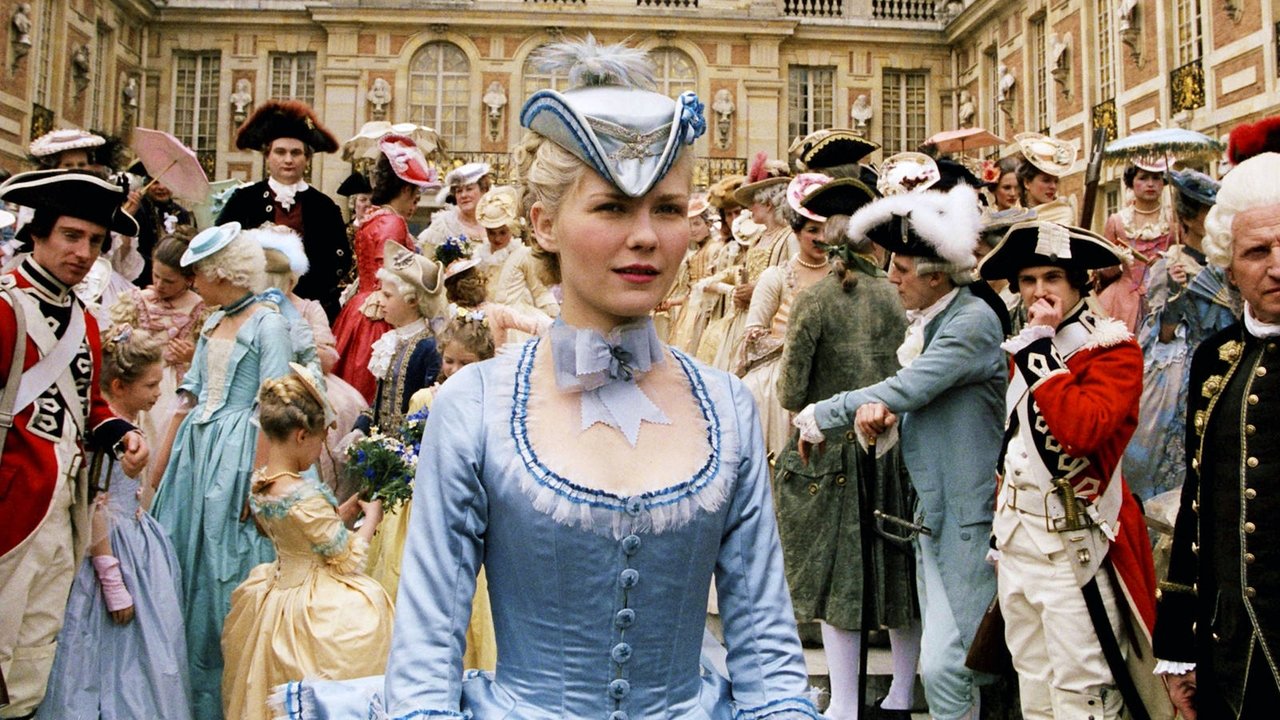
Marie is made to stand vulnerable and naked as strangers reconstruct her into a French queen. Her body, the scene makes clear, no longer belongs to her but to the court. The costume becomes a kind of armor that also functions as a cage, everything about her is now wound so tightly that there's no longer room left for childish feelings.
Excess as Rebellion
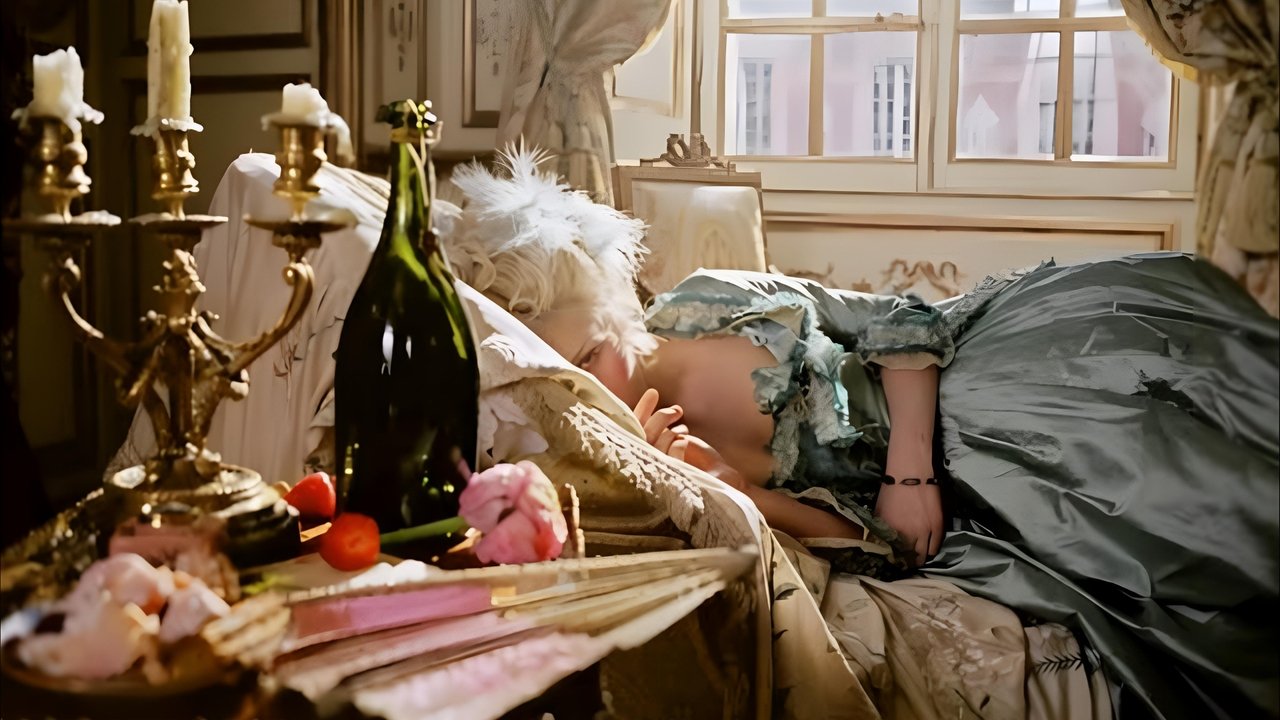
As the film progresses and Marie is more integrated into her life in Versailles, the costuming becomes vibrant and oh so much fun! Or so it seems right? To a viewer the use of floral patterns, bright pinks, and feather detailing seems playful but it still remains in the traditional structured silhouettes that's expected of her. Marie remains who they want her to be and goes along with what is acceptable to her people.
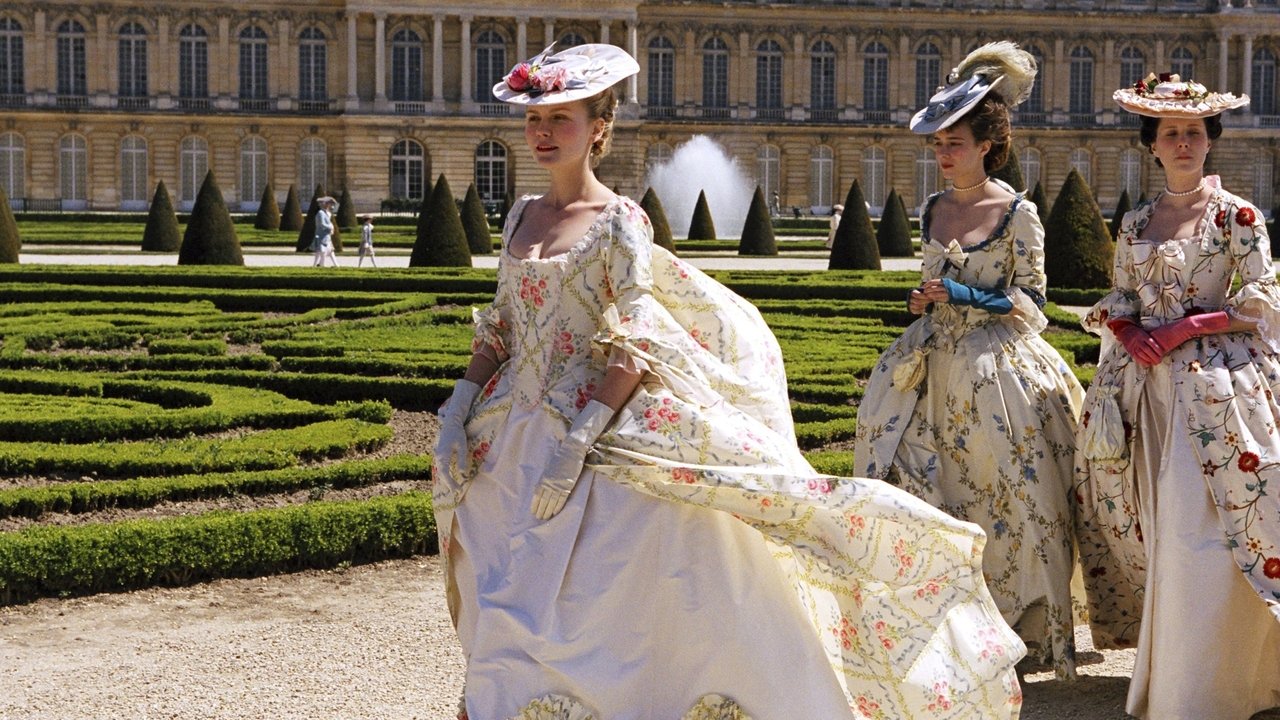
As she finds herself failing to fit into this costume and its demandful role, Marie seems to take on the teenage approach almost to say: you want me to be this thing, fine! I'll take it further than you ever imagined. Money pours into extravagant shoes, oversized gowns, feathers, and pastries galore. The "let them eat cake" excess is made literal in towers of cake, and parties that never seem to end. Beneath the opulence is a very young woman testing her limits and acting out.
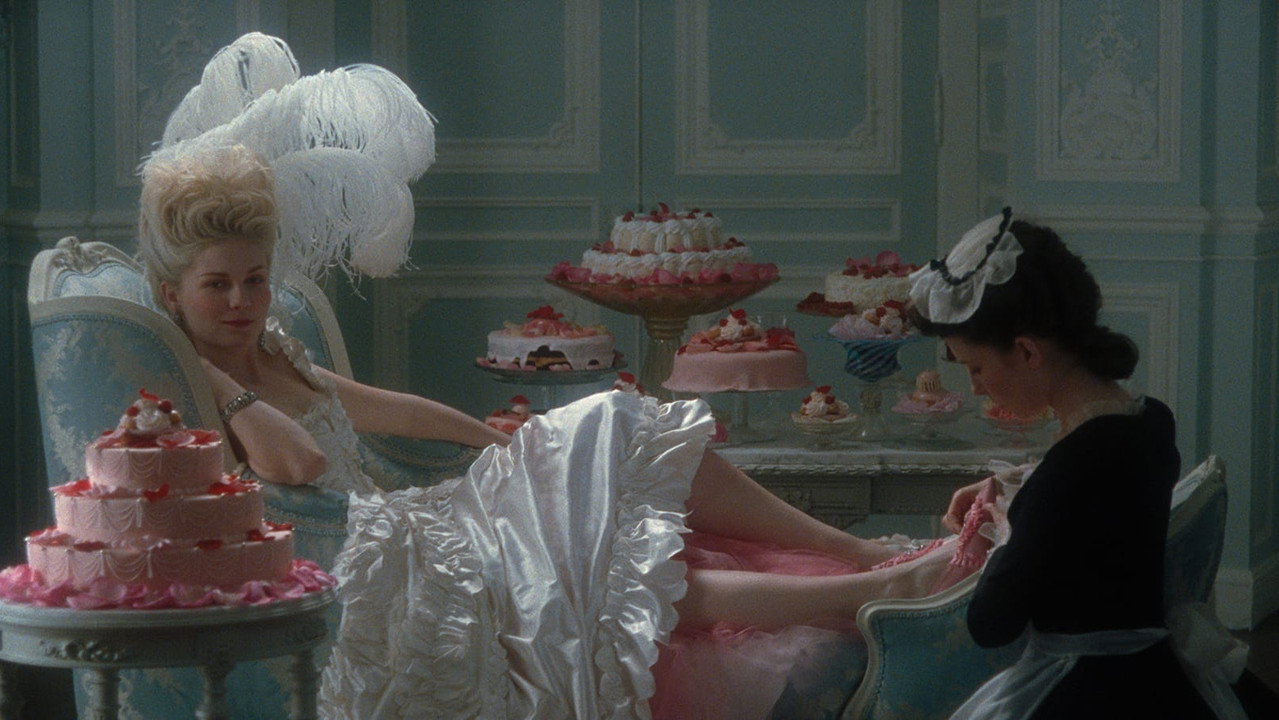
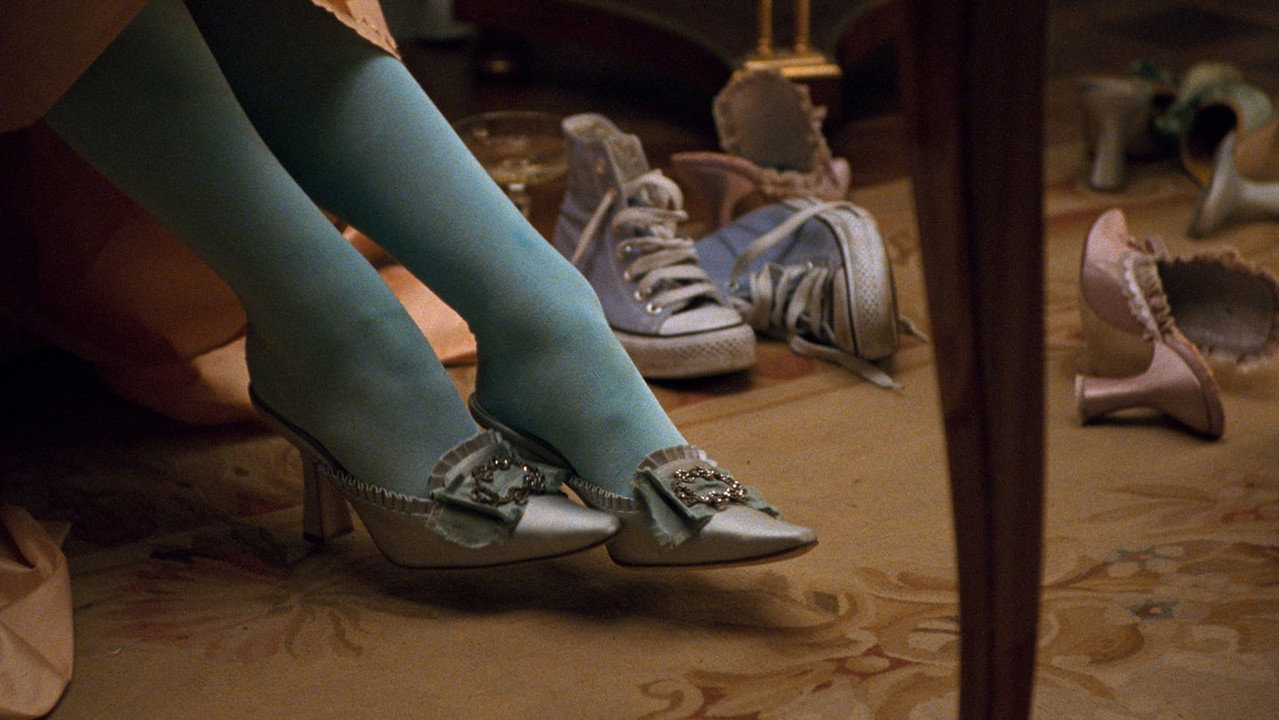
There's genuine, infectious pleasure in watching these wardrobe changes unfold. Coppola even sneaks in a pair of blue Converse tucked beside Marie as she steps into her now chosen heels. A wink and reminder that underneath the wigs and panniers is a teenage girl cosplaying womanhood, having her own private joke with the audience.
But the excess eventually curdles into overload. The patterns, the feathers, the updos piled higher than a neck can comfortably bear seems to reach a visual ceiling. Marie has maximized everything available to her within this rigid system, and there's nowhere left to go but down.
Undressing Toward Selfhood
As the story shifts into a more serious one, Marie's costuming makes its most pointed rebellion yet. This time not through more, but through less. At her private retreat, she strips away color almost entirely in favor of natural fibers: tans, beiges, plain and simple garments. Her hair comes down. Now a mother, she is searching for a version of herself that hasn't been built by the court.
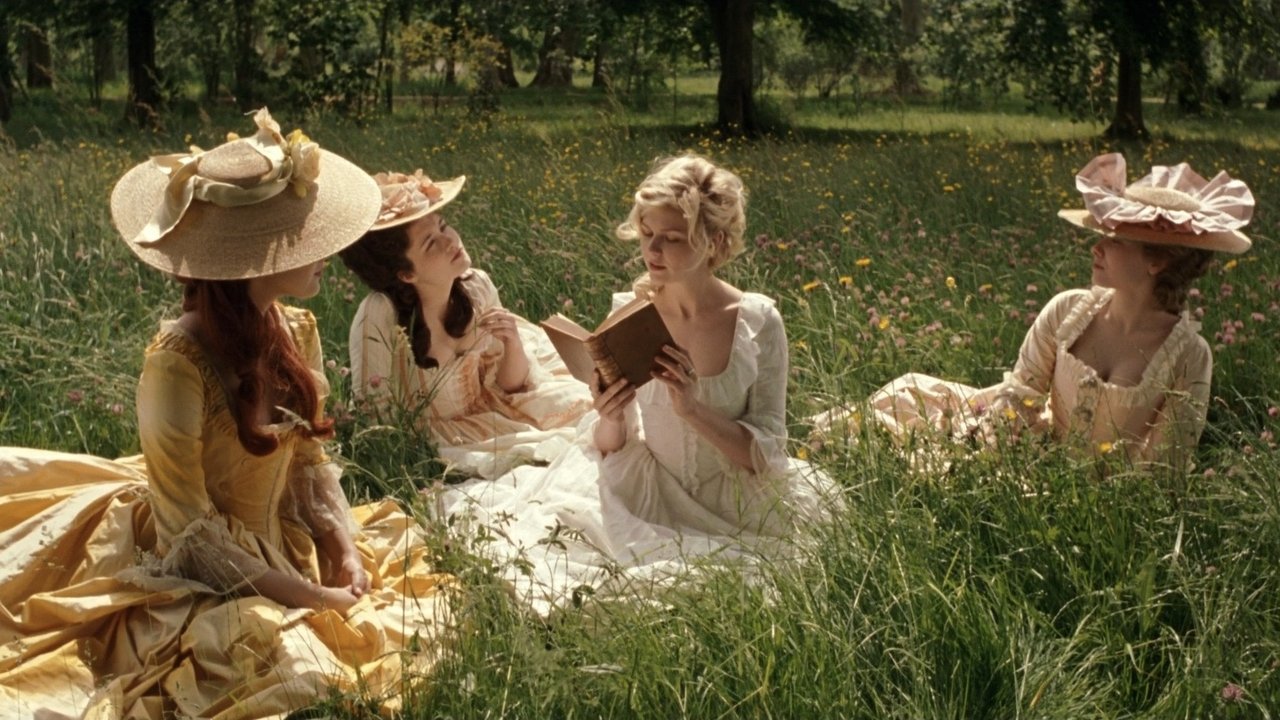
Having already maxed out in excess, she finds a different kind of power in an attempt to reclaim control after living inside a life that had spiraled into ornamental chaos. As the wardrobe quiets, she seems to find more of herself.
The Fall
As the film moves toward its inevitable, unstaged reckoning, the costuming darkens along with the tone. The brightness that defined the film's first half now drains away. When the moment finally arrives and Marie is met with the mob and pitchforks, Coppola declines to show it outright. We're left instead with Marie bowing to her people, dressed plainly, surrendering without spectacle.
There is no final grand gown, no last costume flourish. Just quiet acceptance of the end.
It's a startling contrast to the film's opening dreaminess, and on a first watch it can feel almost anticlimactic until you realize that's exactly the point. There's no final grand gown, no last costume flourish. Just quiet acceptance of the end. The arc, seen through clothing alone, traces a girl trying to become what everyone demanded of her, briefly finding herself in rebellion against it but ultimately accepting she never had the power to choose. For a teenager placed in an impossible position, it's hard to expect more. This is a different era of course but underneath the corsetry, for a moment you empathize with the fact that she was just a kid, and for a while, the whole thing was play.
The credibility layer for what to watch
One scored, argued editorial a month, plus the next TVI Essential. No paid placements. No spam.
Common questions
What is Marie Antoinette about?
Sofia Coppola's 2006 film, adapted from Antonia Fraser's biography, follows the Austrian archduchess from her arrival in France as a fourteen-year-old bride through her years at Versailles. It ends as the family leaves the palace, and never depicts her trial or execution.
Who designed the costumes for Marie Antoinette?
Milena Canonero, who won the Academy Award for Best Costume Design for the film at the 79th Academy Awards in February 2007. This essay reads her work as the film's second script.
Are there really Converse sneakers in Marie Antoinette?
Yes. A pair of pale blue Converse sits among the silk heels in the shoe montage set to Bow Wow Wow's I Want Candy. It is a deliberate anachronism, and the essay reads it as Coppola reminding the audience that a teenage girl is inside the panniers.
Is this essay a review with a score?
No. Marie Antoinette has a title record in the TVI catalog with its score, dimensions, and where to watch. This essay is an interpretation of the film's design and does not set or change that score.
Who is Becca Meshinsky?
Becca Meshinsky writes The Made World, TV Intelligentsia's design and craft column, and is an editorial and product stylist and art director based in Los Angeles. Her essays read films through costume, silhouette, color, and the built world of a production. They are interpretations of the work, not scored reviews, and they do not set or change a title's TVI score.
Film: Marie Antoinette (2006), written and directed by Sofia Coppola, adapted from the biography by Antonia Fraser. Costume design by Milena Canonero. Columbia Pictures. Essay by Becca Meshinsky for The Made World, TV Intelligentsia's design and craft column.