The Invite: The Difference Between Being Watched and Being Seen
Olivia Wilde's funny, unnerving chamber piece turns one apartment into a study of desire, resentment, and what it takes to let another person surprise you again.
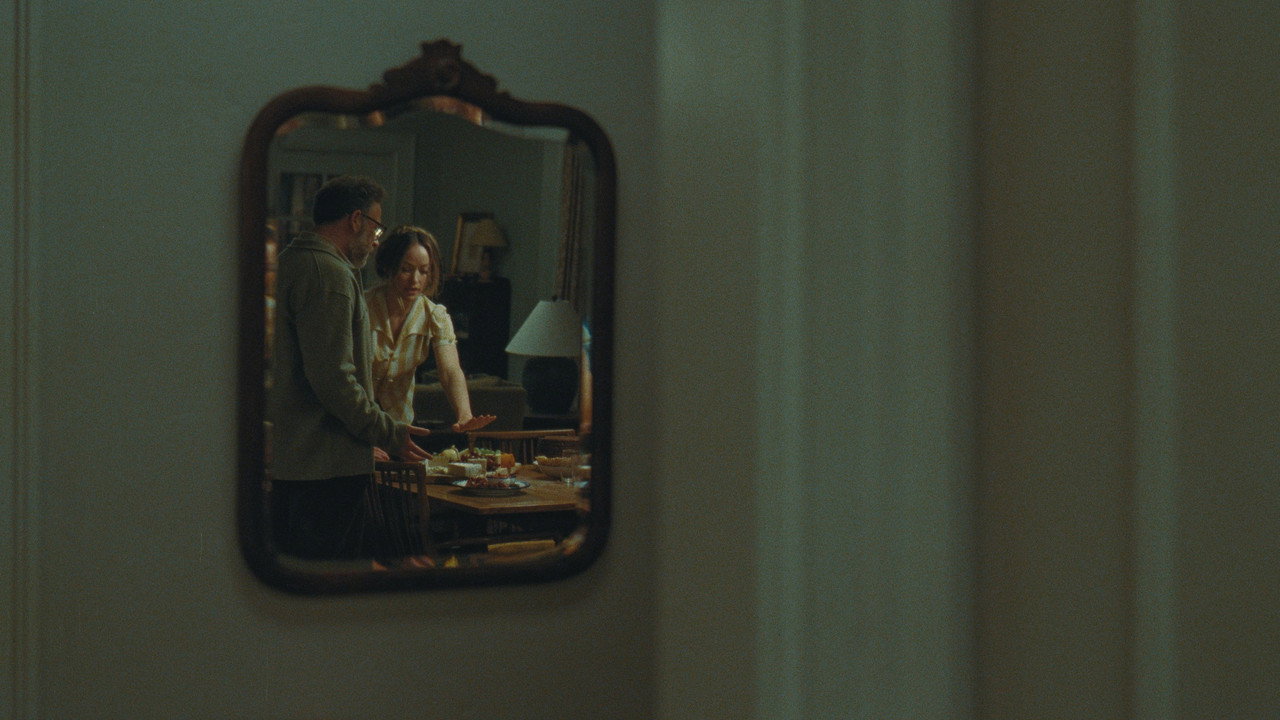
The Invite scores 159/200 on TV Intelligentsia's published methodology, a Stimulating, on a verified receipt. Olivia Wilde's one-apartment dinner party is about the difference between watching a partner and seeing them: the neighbors, the camera, and the window all watch, and the married couple has stopped looking.
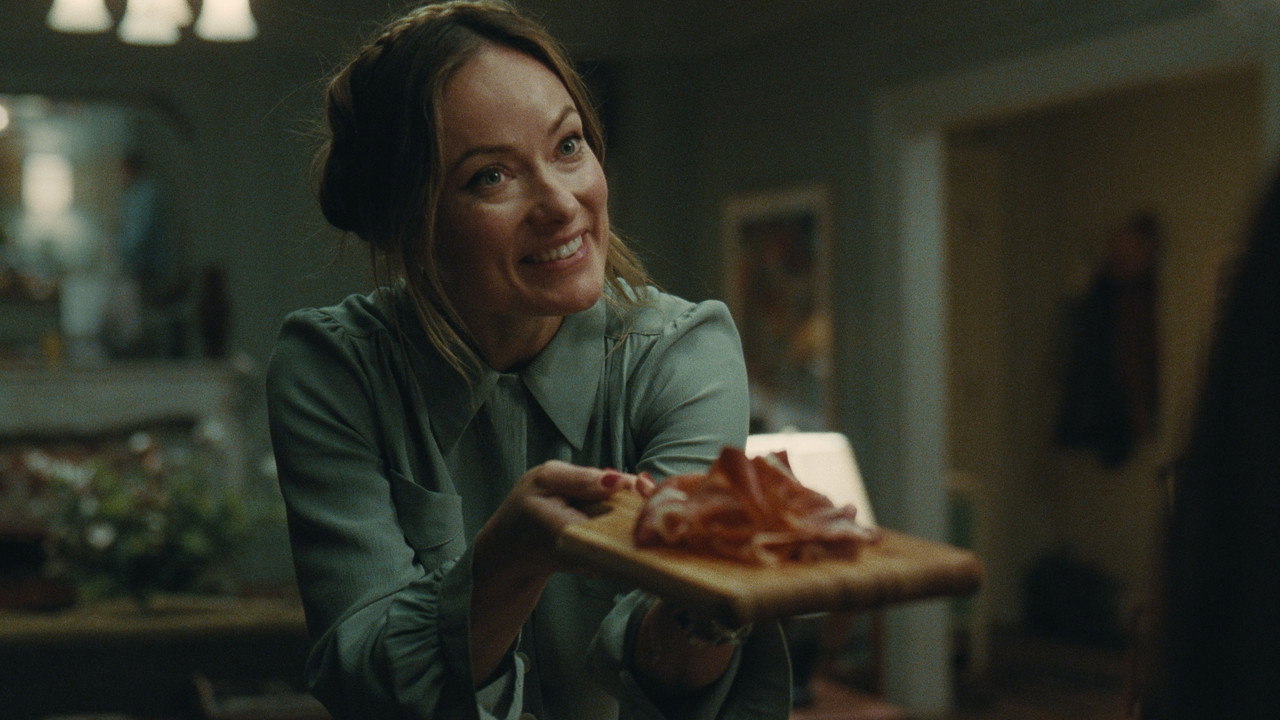
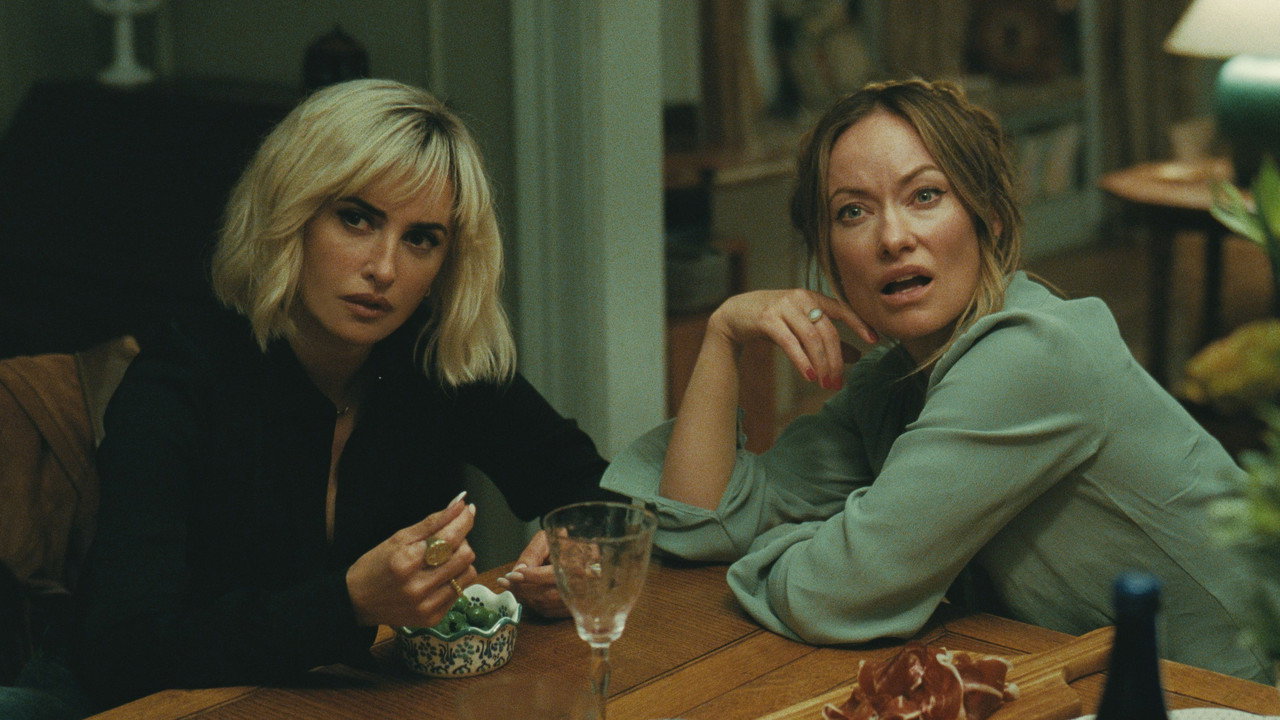
The Invite begins with a dinner party already in trouble. Joe has forgotten the wine. Angela has a soufflé in the oven, an elaborate cheese display, and ten minutes until the upstairs neighbors arrive. Their fallback is leftover New Year's champagne, opened early to lose some fizz. They are still fighting when the doorbell rings. The guests have been outside listening. It is funny, tense, and so well cast that even the most uncomfortable exchanges remain entertaining.
Before long, the neighbors are speaking freely about things Joe and Angela can barely approach without starting another argument. The sexual invitation is the evening's obvious provocation. Its deeper center is attention: who gets it, who wants it, and what happens when the person closest to you thinks they already know everything worth knowing.
Everyone is watching someone. Joe and Angela listen to the neighbors upstairs. A Ring camera catches Joe in an act he will later deny. Angela passes her window naked knowing the man upstairs may be looking. The one thing Joe and Angela are not doing is seeing each other, rather than the versions of each other they have come to expect.
Angela has remade the apartment with care and wants that care to register. The guests notice almost immediately. Joe sees expense, clutter, another demand. He has abandoned the piano and talks about his life as though his failures are simply something that has happened to him that he has no agency to change. Angela remembers the man who made her run eleven blocks back to a bar to find him. The man at home can describe his unhappiness in detail but can no longer imagine changing it.
The film sees more in both of them than they see in each other. Neither is a monster. They are lonely, tired, a year removed from sex, and practiced at hearing accusation in almost everything the other says.
How the apartment directs perspective
In The Invite, the apartment functions as much more than setting. It is the medium that informs the perspective of the characters and the audience. It creates the angles, apertures, lenses, reflections, and points- of-view that externally reflect the inner workings of the film and its characters.
As is the case for much of the film, it makes private things public. Sound carries passion into the bedroom from upstairs, an internal argument reaches the hallway, a window becomes the aperture for exposure. The framing was one of the first things we noted while watching. Then we noticed the mirrors. Wilde and her cinematographer keep finding ways to look at these people from somewhere else: through doorways, in reflections, from an angle that changes what an exchange seems to mean. Where we stand and how we are oriented change what we see.
The plot continually shifts our position too. The neighbors seem intrusive, then liberating, then wiser than anyone at the table. Later, their wounds show too, and each disclosure makes us reconsider who these people are.
The film asks us to do something Joe and Angela have largely stopped doing.
Joe's account of Angela is settled: her decorating is excess, her need for attention vanity, her frustration control. Her account of him is nearly as fixed: stalled, resentful, in need of management. Neither expects to be surprised. Strangers can still meet them with curiosity. At home, each thinks they know what the other will say before the sentence begins.
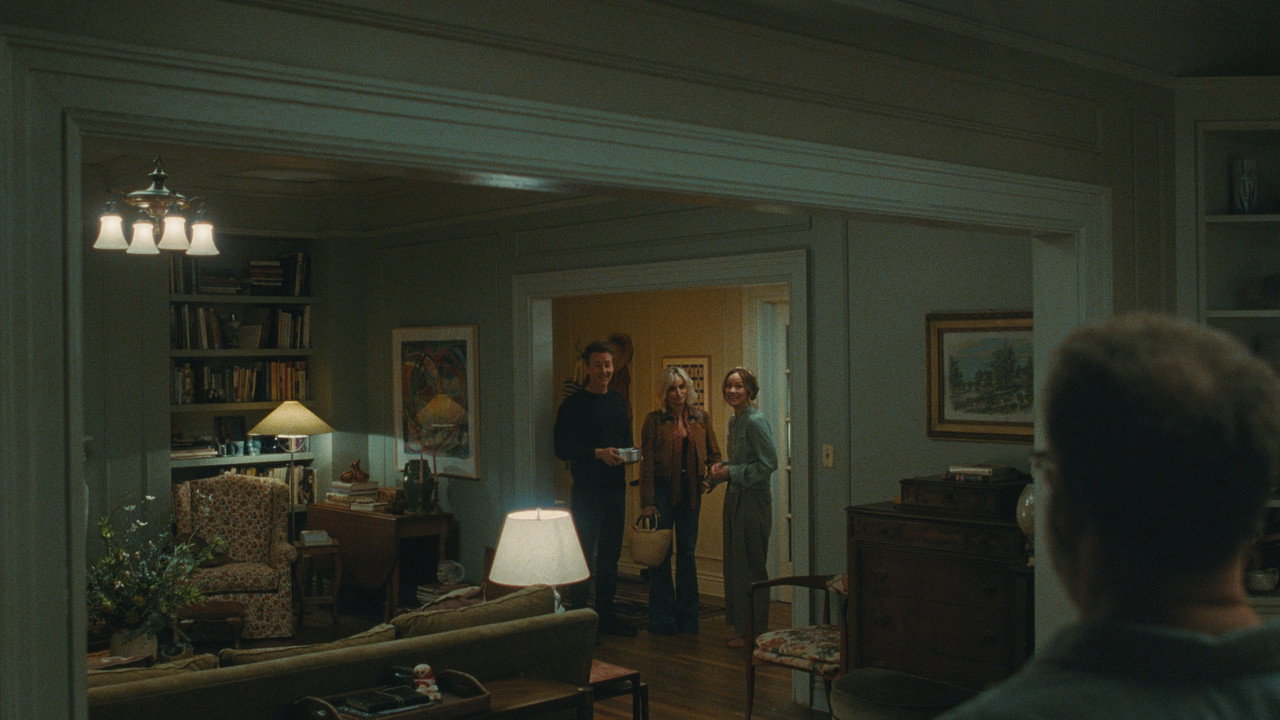
Watching someone can become a way of collecting evidence for a theory you already believe. Seeing them means leaving room for the theory to change.
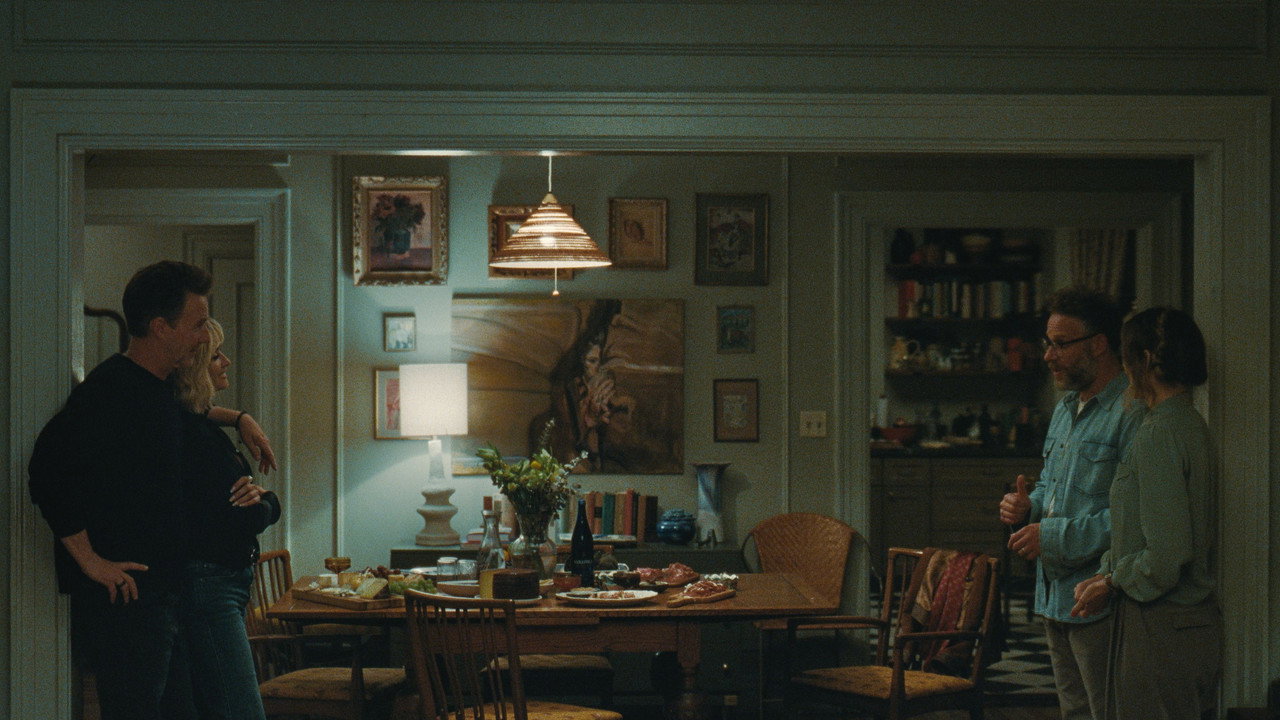
Reaching for a reset
Watching someone can become a way of collecting evidence for a theory you already believe. Seeing them means leaving room for the theory to change. It can be easy to judge with limited information, being curious and open demands more of us. Before the guests arrive, Angela asks Joe to leave the apartment and come back after a poor exchange so they can try again. Anyone who has tried to rescue a bad night will recognize the hope in that request. A little distance, a new greeting, another chance. It is not enough.
Joe returns sarcastic. Angela returns to managing him. The procedure changes, but neither makes room for a different response. He still intends to prove the evening is a mistake; she still intends to get him through it. The reset fails because they bring the old argument back through the door. It succeeds in revealing the core of their dysfunction.
By contrast, the neighbors can discuss consent, jealousy, grief, and desire without turning each subject into an accusation, and to Joe and Angela that freedom to speak sounds close to freedom itself.
Then the guests begin correcting and interrupting each other. That does not make their philosophy fraudulent. It means they are human and susceptible to the same modes of failure as Angela and Joe. Having insight doesn't mean that you will act on it perfectly, but provides the opportunity. That inclusion in the film makes it better and more believable. It is also a strong reminder that even those who seem to have all the answers are still working through their own shit.
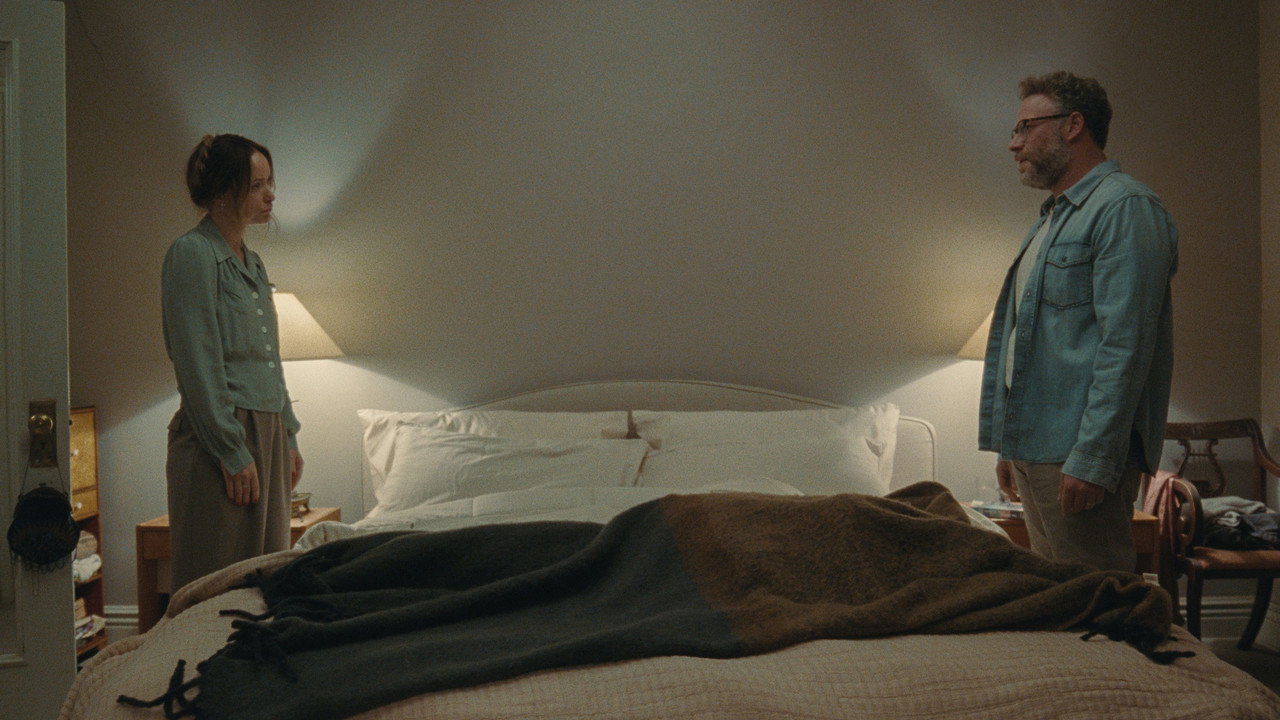
When the joke is on us
Edward Norton's Hawk is easy to mock, especially once Joe learns that the name is one he chose for himself. The jokes are funny. Then Hawk explains why he needed a new name. After his wife died, he saw how thoroughly he had closed himself off to someone he loved, and reinvention became his attempt to make things right and change his way. This is one of the master strokes of the film. It is easy to have Joe's perspective on Hawk, and for most of the movie, you likely do, but it is a stark reminder of just how wrong our perspectives can be.
For Joe, his contempt is protection. If Hawk is merely ridiculous, he has no reason to change.
His band failed, his work disappoints him, and the home he lives in reminds him of what he did not achieve. Those disappointments are real. So is the way he has made them an explanation for no longer trying. His back pain is an extension of that misery, not a shortcut to explaining it.
Angela's response to disappointment is more active. She fills the apartment with beauty and projects, hoping the attention she gives the place will somehow return to her. The window offers a more direct response. She passes it knowing Hawk may be watching, without ever making eye contact. At a distance she can feel desirable without negotiating the weary history of her marriage. Being watched can allow her to feel desired when her marriage does not. It cannot give her the harder thing, feeling seen, feeling safe, and feeling connected.
The proposal of a consensual night together briefly promises a larger escape. The film does not make sexual openness the problem or monogamy the answer. But Joe and Angela cannot leave their relational baggage out of it. Who wants whom, who feels chosen, who is still angry: those questions follow them into the possibility of pleasure. The evening becomes less of an escape than the conversation the couple has been avoiding.
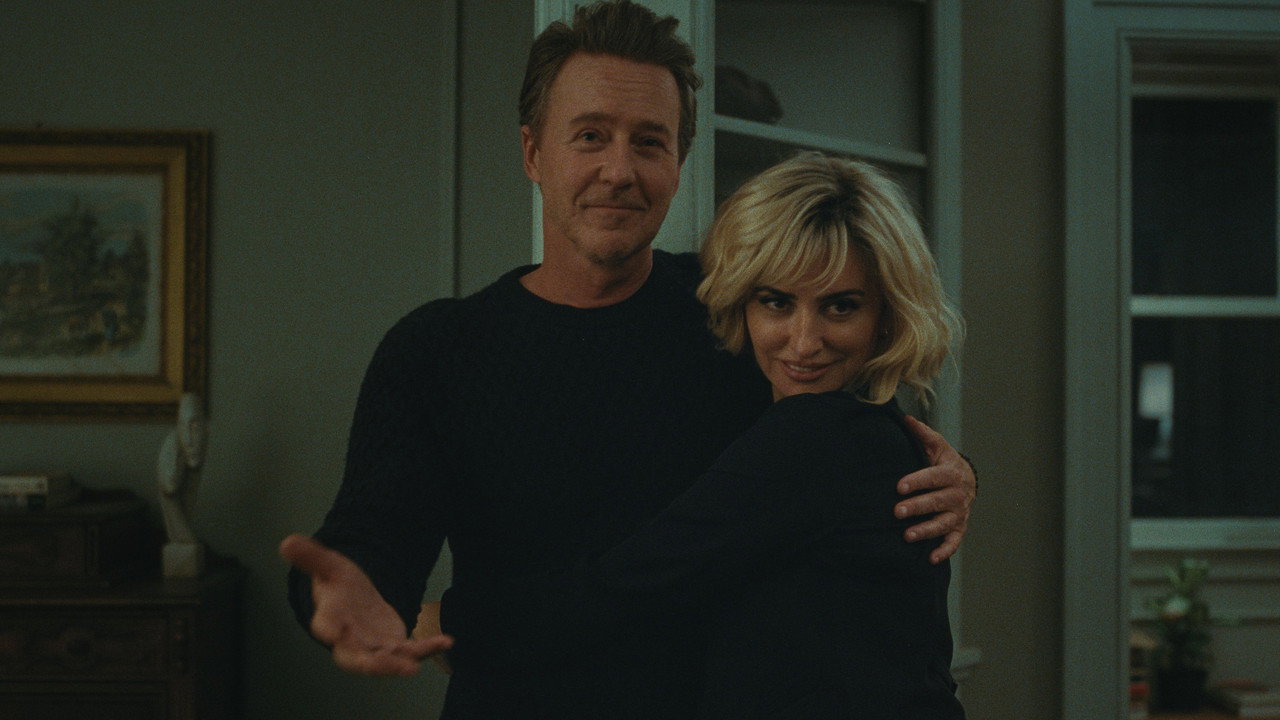
Being watched can allow her to feel desired when her marriage does not. It cannot give her the harder thing, feeling seen, feeling safe, and feeling connected.
Harmony returns at the piano
It is a stark reminder that our problems are still there, even when we try to escape from them. The sharpest intervention comes from Piña, Penélope Cruz's character, whose own fallibility does not stop her from recognizing what is happening. She has described a first marriage that ended long before it ended formally: no sex, no conversation, two people becoming strangers. Now she asks whether staying together in misery is really better for a child than separating.
Their daughter Maggie, away at a sleepover, has become a reason to preserve the marriage. The question is whether she is better off with unhappy parents together or happy parents apart. The film lets the question hurt without pretending an outsider can answer it for them.
Piña insists their relationship is over, but notes the possibility of a new relationship with the same person.
Joe's return to the piano gives that possibility a small, specific form. It reads less like a gesture designed to win Angela back than a return to the type of man he used to be. The reset asked them to change the evening while staying exactly as they were. The piano is a different kind of reset, one that invites them to return to an early dynamic in their relationship.
Angela watches him differently. His playing recalls the man she once ran back to find, but the film does not pretend that a familiar glimpse repairs a marriage. The harder work would come in the ordinary moments when each has learned to expect the worst of the other.
The film has spent the evening changing our view of four people. It leaves Joe and Angela facing the same task with each other. Can they build a new relationship with the same person, or will seeing each other clearly finally allow them to leave? At the end of the film, that insight and freedom to actually choose are the invite. The Invite (2026), directed by Olivia Wilde, written by Rashida Jones and Will McCormack, from Cesc Gay's stage play and 2020 film The People Upstairs. A24. With Seth Rogen, Olivia Wilde, Penélope Cruz, and Edward Norton. 107 minutes.
For parents: the real age of access
The rating is R, and the premise is the reason. The film is about two couples deciding whether to spend the night together, and it lets them talk about it the way adults do, with unfiltered language and brief nudity at the window. Nothing is graphic in the way the premise implies. The real age of access is late teens, because the film's subject is a marriage that has stopped being curious, and that is legible only to someone who has watched one up close. Seventeen and up. The conversation worth having afterward with an older teen who has started dating is the one the film is built on: the difference between watching someone and seeing them.
The record
The Invite scores 159 out of 200 on the TVI IQ Score, Stimulating tier: Cognitive Stimulation 40, Educational Value 37, Craft and Quality 43. The score is verified under TVI's current standard, receipt b6a7da11. The prior catalog score was 147; the reassessment is recorded on the corrections page.
Scored jointly by Jordan Robinson with Cordelia Witty, EdS., NCSP, watching together in one recorded session on August 30, 2026: complete film, first viewing, with the prior TVI score and tier withheld until lock. The TVI IQ Score is a content rating, not an intelligence measurement.
The credibility layer for what to watch
One scored, argued editorial a month, plus the next TVI Essential. No paid placements. No spam.
TVI Score Breakdown
| Dimension | Weight | Score |
|---|---|---|
| Cognitive Stimulation | 40% | 40 / 50 |
| Educational Value | 35% | 37 / 50 |
| Craft & Quality | 25% | 43 / 50 |
| TVI Score | 159 / 200 · Stimulating |
Formula: round((C × 0.40 + E × 0.35 + Q × 0.25) × 4) = 159. The three weighted dimensions do not sum to the total; the formula scales them.
Disclaimer: TVI's score is a content rating, not a measurement of intelligence.
Common questions
What is The Invite's IQ Score?
The Invite scores 159 of 200 on the TVI rubric, Stimulating tier, with Cognitive Stimulation 40 of 50, Educational Value 37 of 50, and Craft and Quality 43 of 50. The score is verified on a public receipt; the prior catalog score of 147 was reassessed on August 30, 2026.
Is The Invite about an open marriage?
The neighbors' invitation to a consensual night together is the evening's obvious provocation, but the film does not make sexual openness the problem or monogamy the answer. Its subject is attention: who gets it, who wants it, and what happens when the person closest to you thinks they already know everything worth knowing.
What is The Invite based on?
Olivia Wilde's film is written by Rashida Jones and Will McCormack from Cesc Gay's stage play and 2020 Spanish film The People Upstairs (Sentimental). It stars Seth Rogen, Olivia Wilde, Penelope Cruz, and Edward Norton, runs 107 minutes, and was released by A24 in 2026.
Film: The Invite (2026), directed by Olivia Wilde, written by Rashida Jones and Will McCormack, from Cesc Gay's stage play and 2020 film The People Upstairs. A24. With Seth Rogen, Olivia Wilde, Penélope Cruz, and Edward Norton. 107 minutes. The IQ Score is a content rating, not an intelligence measurement.