After watching: this article discusses the plot.
Before and after Wendy and Lucy
Choose a resource for where you are in the viewing. Content details are labeled.
Before watching1 resource
- Score & viewing detailsWendy and Lucy: score and viewing details
The catalog record, score status and viewing options.
Content details may appear in the rationale
After watching1 resource
- ReviewFilm reviewWendy and Lucy, and the Subtle Hum of Modern Life
The critical argument, for reading after you have watched.
Plot details; may discuss the ending
Wendy and Lucy, and the Subtle Hum of Modern Life
Kelly Reichardt’s 2008 film follows Michelle Williams as a woman whose best laid plan to reach Alaska comes apart, one small piece at a time. It runs 80 minutes, but stays with you long after.

Wendy and Lucy (2008) scores 135/200 on TV Intelligentsia's published methodology, Stimulating. Jordan Robinson's review of Kelly Reichardt's film follows Michelle Williams as Wendy, whose plan to reach Alaska comes apart in an Oregon town when her car fails and her dog goes missing, and listens to the hummed tune that opens and closes it. The film is streaming on OVID.
This review contains spoilers, including the ending.
Before Wendy says much of anything, we hear the melody of hums that seem to complement the pace of her living. Wendy and Lucy opens on freight trains and a slow tracking shot of Wendy and her dog, Lucy, walking through the trees. Will Oldham wrote the melody for Michelle Williams to hum, and it is nearly the only music in the film.
The woman humming is Wendy Carroll, and she has a plan. She is driving north to Ketchikan, Alaska, where she hopes to find work at a fish cannery, with Lucy, her car and a few hundred dollars. Robert Burns has a line for what happens next. In “To a Mouse,” written in 1785 after his plough turned up a mouse’s nest, he wrote that “the best laid schemes o’ Mice an’ Men / Gang aft agley.” They often go wrong. Wendy’s comes apart over almost nothing.
A Series of Unfortunate Events
Wendy has stopped in a small Oregon town. She spends an evening by a campfire with a few young drifters, then sleeps in her car in a store parking lot. In the morning a security guard knocks on the window to move her along, and the car will not start. The dog food has run out too. Either problem alone she might manage. Together, they cost more than she has.
So she ties Lucy to a bike rack outside a grocery store and tries to slip out with a few cans of dog food in her backpack. A teenage stock boy catches her cold. She tries to explain herself, and it does not matter. He tells her that if you can’t afford dog food, you shouldn’t have a dog. The store, it turns out, has a policy, and the policy is the police. Wendy is booked and fined $50, money she cannot spare. By the time she gets back to the store, Lucy is gone.
Inside the supermarket, the tune from the opening titles plays as background music on an organ, in the very place her trouble starts.
The store, it turns out, has a policy, and the policy is the police.
Without the car she has nowhere to sleep. The repair shop takes it, and Wendy spends her days on foot between the pound, the shop and the streets where she has put up flyers for Lucy. At night she sleeps in the woods, where a man frightens her badly in the dark. Help comes, but only so much of it. The guard who moved her along, played by Walter Dalton, lets her use his phone to call the pound, and later slips her a little money he can barely spare. The mechanic, played by Will Patton, has the harder news: the car would need to be rebuilt, and she has no way to pay for it.

Reunited and It Feels...
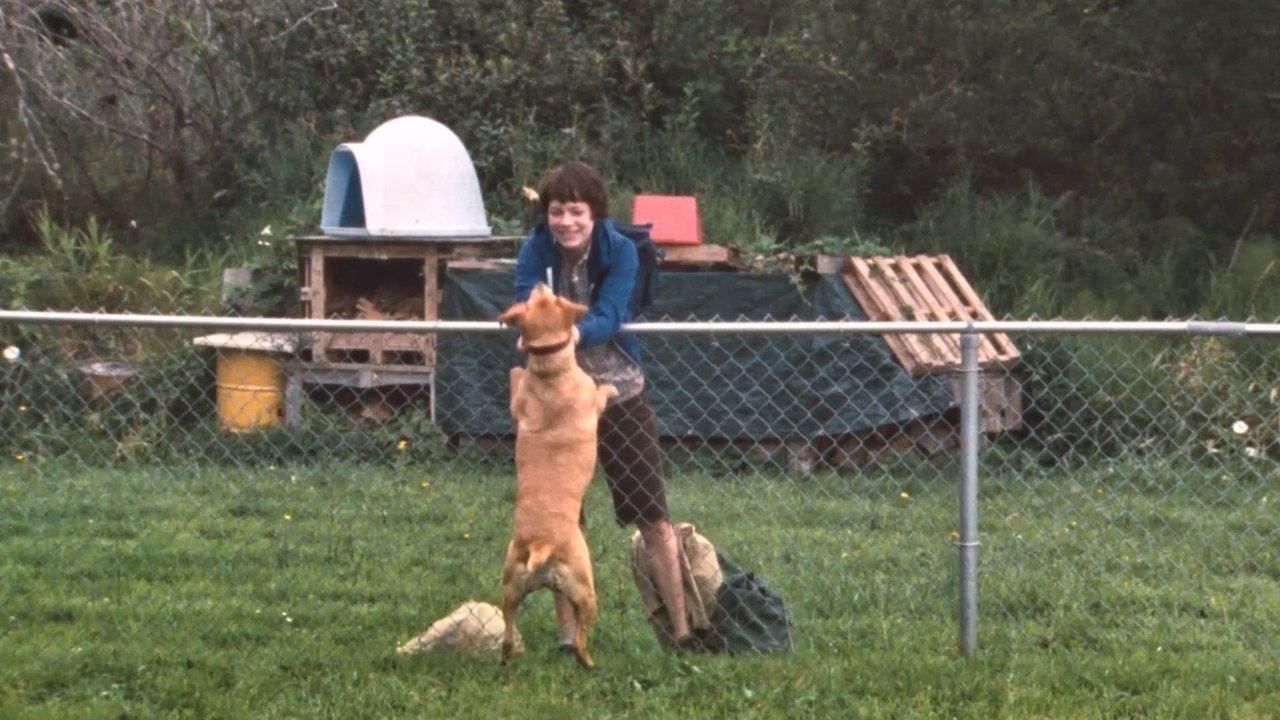
Lucy turns up at last. The pound has placed her with a family, in a house with a fenced yard, and when Wendy finds her there, Lucy comes running to the fence. The stock boy meant his line as a lecture. Here it simply comes true. Wendy has no car, nowhere to sleep and less money than she started with, and she cannot care for Lucy the way she wants to. The family seems kind. So she gives Lucy up, not because she wants to, but because she loves her too much to keep her in that life. She promises to come back once she has made some money, and she means it. Life has not left her room to keep that promise yet. Then she hops a freight train north, alone.
A Taste of Life That Lingers
What stayed with me was the humming and what it seemed to represent. It is not a sad tune. To me it sounds close to joyful, and it knows what the film knows: life is complicated, full of ups and downs, and it keeps going whether you are ready or not. The trick is not to be broken by it. Even when life gets “ho-hum,” you can hum, and move to the melody of life.

Reichardt wanted the first and last shots to move, the cinematographer Sam Levy has said, so that one would bookend the other “like a train.” The tune does the same. The film opens on freight trains rolling in and Wendy humming, and it closes on a freight train carrying her out, with a few last hums before the score takes over.

It is not a sad tune.
Wendy came into town with a car, a dog and a plan. She leaves with only the plan. Burns was right that the best laid schemes go wrong. He never said you have to stop.
Wendy and Lucy is streaming on OVID. This review is part of a series TV Intelligentsia is writing with OVID on films from its catalog.
The Intelligentsia Report
Film and television criticism, watch guides, and updates from TV Intelligentsia. Free. Unsubscribe anytime.
TVI Score Breakdown
| Dimension | Weight | Score |
|---|---|---|
| Cognitive Stimulation | 40% | 27 / 50 |
| Educational Value | 35% | 37 / 50 |
| Craft & Quality | 25% | 40 / 50 |
| TVI Score | 135 / 200 · Stimulating |
Formula: round((C × 0.40 + E × 0.35 + Q × 0.25) × 4) = 135. The three weighted dimensions do not sum to the total; the formula scales them.
Disclaimer: TVI's score is a content rating, not a measurement of intelligence.
Common questions
What is Wendy and Lucy's IQ Score?
Wendy and Lucy scores 135 of 200 on the TVI rubric, Stimulating tier, with Cognitive Stimulation 27 of 50, Educational Value 37 of 50, and Craft and Quality 40 of 50.
What is Wendy and Lucy about?
Kelly Reichardt's 2008 film follows Wendy Carroll (Michelle Williams), who is driving to Ketchikan, Alaska, to look for cannery work with her dog, Lucy. When her car breaks down in a small Oregon town, she is caught shoplifting dog food, and while she is held, Lucy goes missing. Reichardt wrote it with Jon Raymond from his short story "Train Choir". It runs 80 minutes.
What is the tune in Wendy and Lucy?
A short hummed melody written by Will Oldham, who also plays Icky in the film; Reichardt has said he wrote it for Michelle Williams to hum. It is nearly the only music in the film. It comes in over the opening titles, plays in the supermarket, and returns at the close.
Where can I watch Wendy and Lucy?
Wendy and Lucy is streaming on OVID, at ovid.tv/videos/wendy-and-lucy. This review is part of a series TV Intelligentsia is writing with OVID on films from its catalog.
Film: Wendy and Lucy (2008), directed by Kelly Reichardt, written by Jon Raymond and Kelly Reichardt from Raymond's story "Train Choir". Oscilloscope Laboratories. With Michelle Williams, Walter Dalton and Will Patton. Streaming on OVID. The IQ Score is a content rating, not an intelligence measurement.