I went to TPAC for the spectacle. That is the honest beginning. The reputation arrives before the curtain does: the creators of South Park, the songs people quote with a half-apologetic grin, the show that managed to become both a Broadway juggernaut and the most cheerfully sacrilegious thing a touring company can bring through Nashville.
It delivers on that reputation fast. The language is not merely profane. It is aggressively, joyfully, and architecturally profane. One of the first big numbers, sung by the Ugandan villagers, is built around a phrase the show itself translates as an obscenity thrown at God, staged with the bright precision of musical comedy. The contrast is the joke and the wound at once. You laugh because the staging tells you to, and then you catch what the line means: people with nothing left telling heaven exactly what they think of its silence.
That is the first sign the show is doing more than trying to offend you. The obscenity is not decoration. It is theology from the bottom of the pit, what belief sounds like when belief has not been answered.
I could feel it in the room, a palpable, collective energy that ran through the whole night, an audience laughing hard and then, under the laugh, registering what it was laughing at.
The room began by treating the profanity as the event, while the profanity was quietly working as camouflage. What looks like an attack on belief becomes a question about why belief survives at all, and about how a story can shape a life long after its claims have fallen away. I did not expect the show to take that question seriously, but that is precisely what made the night work.
The only honest character is the one who makes everything up
The engine of the show is Elder Cunningham, a frightened, lonely, socially stranded kid who cannot do the one thing his religion asks of him. He cannot remember the scripture.
He is sent to Uganda beside Elder Price, the golden missionary who expected greatness and dreamed of Orlando. Price arrives with ambition, posture, doctrine, and the right answers. Cunningham arrives with need. He wants friendship. He wants to matter. He wants, desperately, to be useful to someone.
The villagers they meet are not waiting for doctrinal precision. They are living inside terror, illness, poverty, violence, and a God who appears to have stopped returning calls. Price gives them the correct version of the religion and fails.
Cunningham, with no command of the material and no confidence in himself, begins to invent.
He splices Mormon teaching with Star Wars, Star Trek, Tolkien, and whatever else his anxious mind can reach. As theology, it is nonsense. As scripture, it is fraud.
And it works.
The made-up religion does what the true version, delivered correctly, could not. It reaches the people in front of him. It gives them a frame for fear, a language for endurance, a reason to stand together.
A story does not have to be scripture to do that. Hope, direction, a way to read your own life: these come from invented stories as readily as from sacred ones, which is the quiet heresy running under the jokes. And Cunningham works for a precise reason. He answers the fear that is actually in front of him, where the orthodox version keeps offering antiquated doctrine to problems it was never shaped to meet.
That is the show's most dangerous idea, and the reason it has outlasted its own scandal. Cunningham is lying. The show never pretends otherwise. But his lie is also the first fully sincere act in the room, because it is aimed at the needs of the people listening rather than the institutional requirements of the message.
The fraud is the love.
That sentence should make any serious viewer uncomfortable. It made me uncomfortable. The show has the nerve to mean it.
What a story is, and what a story does
This is where The Book of Mormon becomes more than a successful provocation.
Strip away the shock, the tuneful blasphemy, the obscene glee, and the show makes one distinction again and again: the difference between what a story is and what a story does.
Cunningham's gospel is false as fact. It is true as function.
But function understates it. Cunningham's gospel is not a useful lie. It is an accurate account of a different subject. It is false as cosmology and true as anthropology: wrong about the universe, right about the people in front of him, their fear, their need, the shape their endurance can take. The flaw in it is not falsehood. It is a category error. He gives the villagers a true description of themselves and files it under the heavens, and the show's nerve is to see that the misfiling does not make the description false. The oldest stories last not because they are useful but because they are accurate about something the literal register cannot reach.
That does not make it harmless. It does not make lying noble. It does not mean doctrine is irrelevant, or that truth can be discarded whenever a metaphor feels useful. It would be easy to congratulate the show for that cleverness and stop there.
The harder claim is the one worth sitting with.
The show is not saying truth does not matter. It is saying that human beings often survive by means of stories whose literal claims matter less than the structure of meaning they provide. A story gives suffering a sequence. It gives fear a shape. It gives people a part to play when chaos has made them passive.
That is not a small thing. It is one of the oldest uses of narrative, and it is where the show meets the premise of this publication. Our scoring measures what a work is: its cognitive demand, its educational value, its craft, whether the thing is well built. It stays deliberately silent on what no score can responsibly capture, the private consequence of a story, the way a fiction can hand a person a sentence for a feeling they could not otherwise name.
The show arrives at that same boundary from the other side. We reach it by admitting that a number cannot measure what a story does to a life. Cunningham reaches it by discovering that what a story does can outlive the collapse of what it claims. That convergence is why TVI can say something here a conventional theater review may not. The Book of Mormon is finally a work about the gap between the thing you can measure and the use a frightened person makes of it.
A story is not only what it says.
It is also what it makes possible for the person who experiences it.
The problem the show cannot sing away
A serious defense of The Book of Mormon has to name the thing its defenders move past too quickly. The show is not equally cruel to everyone.
The satire of the Mormon missionaries is sharper than it is usually given credit for, but it is also affectionate. The show likes them. It understands their earnestness, their repression, their mythology, and their hunger to matter. The religion it names directly is mocked, and also given a real inner life, not just a target.
The Ugandan villagers are treated differently. They are not drawn with comparable specificity. They are assembled from a Western inventory of African catastrophe: disease, violence, poverty, superstition, warlords, despair. The show needs them desperate enough for Cunningham's invented gospel to function, and that dramaturgical need comes at a cost. They absorb a cartoonish cruelty the Mormon characters are spared. The usual defense is that the show offends everyone, and that is not quite true. It offends everyone loudly, but not equally. The Mormons are a real institution teased from close range. The Ugandans are a theatrical construction built to carry the extremity of the joke.
That is the blind spot, and it does not cancel the work. A serious argument can live inside a flawed vessel, and some of the most important works do. But the flaw is not peripheral, and it should not be hidden under applause, because it sits directly beside the show's best idea. The exception is the proof of it. Nabulungi, the chief's daughter, is the most fully written character outside the missionaries, handed the production's best song and its most genuine arc, and the role rewards a real performer. That the show can draw her with that much care, and the village around her with so little, is the whole imbalance in one frame. The show argues that stories should meet people where they are. It does not always meet its own African characters with the same care.
The people most entitled to be offended understood it first
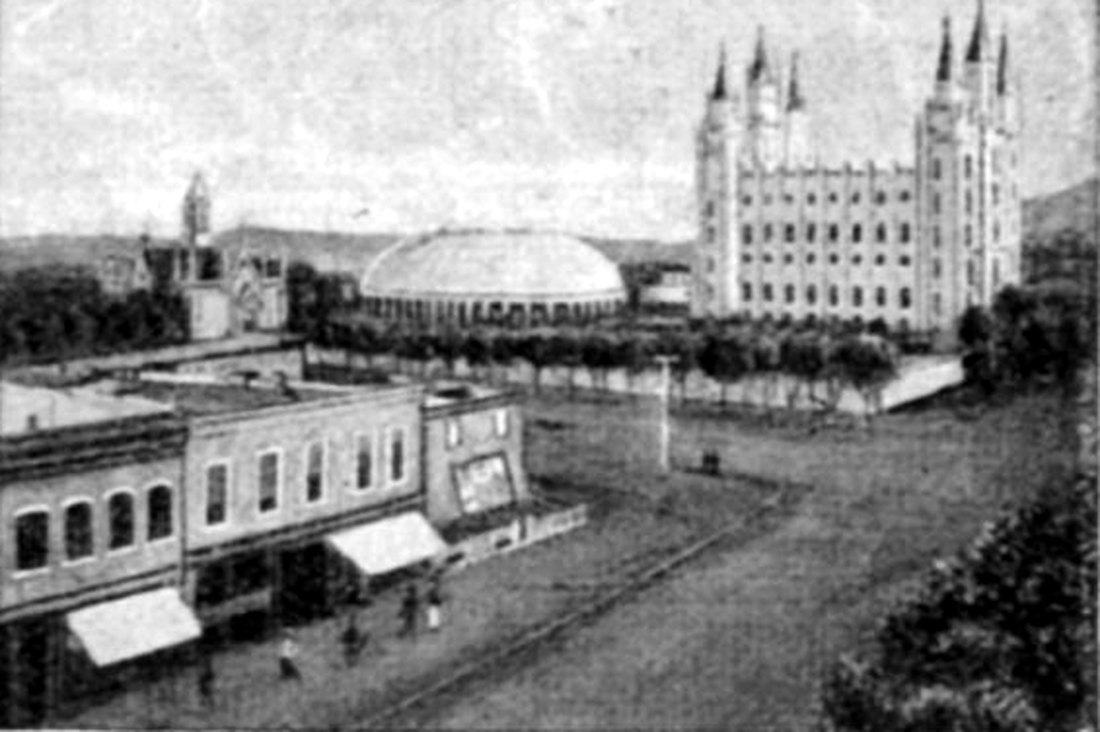
When the tour reached Salt Lake City in 2015, it should have been the confrontation the culture had been waiting for: the most famous Mormon satire in America arriving two blocks from the Church's flagship temple. Instead, by opening-night accounts, there were no major protests outside, no mass walkouts inside, and the audience gave the show a standing ovation.
That reaction is more revealing than outrage would have been.
The Church had set its tone at the very start. When the musical opened on Broadway in 2011, its entire official response was a single sentence: the production may entertain audiences for an evening, but the Book of Mormon as scripture will change lives forever. No condemnation, no call to boycott, just a quiet insistence on the difference between an evening and a life. By the time the show reached Los Angeles in 2012, the Church had gone further and bought advertising space inside the musical's own playbill, with lines like the book is always better and you have seen the play, now read the book. When the tour was announced for Salt Lake in 2015, the Church simply reiterated the original sentence, and the playbill there carried several of the ads.
That is not the move of an institution unable to recognize itself. It is the move of one confident enough to know the difference between ridicule and annihilation, and shrewd enough to turn a two-hour satire into a reading invitation. The Church's framing and the show's turn out to be the same distinction stated from opposite pews: an evening's spectacle is one thing, and a story's lasting use is another.
Trey Parker once compared playing the show for Mormons to performing Fiddler on the Roof for Jewish audiences. The comparison names the paradox. Insiders often laugh first, because they can feel the affection under the blow. They know what is being mocked, and they also know what is being preserved.
The show takes Mormon claims and makes them absurd.
But it takes Mormon stories seriously.
It takes seriously the impulse to cross an ocean for strangers, the need to offer meaning to people in pain, the strange human possibility that a missionary can be foolish, naive, wrong, and still be trying to love the world.
That is what the Salt Lake audience understood before many of the people reviewing it.
The show is not defending the claims.
It is defending the human function of the stories.
What the lie reveals
The strangest thing about The Book of Mormon is that its profanity finally becomes less interesting than its sincerity.
Not because the profanity disappears. The show stays filthy from first number to last, and it earns every warning attached to it.
But shock has a short half-life. Once the audience acclimates, what remains is structure, and the question underneath the obscenity: what kind of story reaches a person who has already been abandoned by every polite answer?
Elder Price has the correct story and cannot make it live.
Elder Cunningham has the wrong story and somehow gives it breath.
The musical does not resolve that contradiction. It lets the contradiction sing.
That is the source of its power and its danger. It asks us to consider that some stories are held not because they are provable, but because they help people endure what proof cannot touch.
That line has to be drawn, because the show's idea is one bad-faith reading away from a license. If a story is true as function, what stops true as function from excusing any lie told for someone's good? The show has an answer, and it is not a soft one. A story is medicine when it keeps the person in conversation with the world, still listening, still able to take in what would correct it, still in contact with the whole life around them. A story is a cancer when it demands the opposite, when holding it means shutting out every signal that threatens it, when the price of the comfort is that you stop listening. A cell turns malignant at exactly that moment, when it keeps its one function and refuses every signal that would correct it. Consolation leaves a person more in the world. Manipulation walls them off from it. Same gift, opposite direction.
And the musical supplies its own proof. Watch what Cunningham builds, then watch what he does with it. He does not install himself at the center of the religion he invents. He disappears into it, and by the end the villagers are running their own pageant, telling their own version, no longer needing him to hold it for them. A manipulation never permits that. A cult keeps the founder at the center, because the founder is the point. Cunningham makes himself unnecessary. A freeing story points past the teller, toward the life of the person it reaches; a binding story points back at the teller. By that measure, the show's gospel passes a test it never bothers to name.
The stories we live by come in registers. Sometimes they are literally true.
Sometimes they are metaphorically true.
Sometimes they are false in one register and indispensable in another.
The best art knows the difference.
The most dangerous art knows the difference and makes us feel it.
That is what happened to me at TPAC. I arrived ready to watch a musical get away with being obscene. I left thinking about the ethics of consolation, the limits of literalism, and the possibility that a story can fail as doctrine and still succeed as mercy.
That is a great deal to ask a dirty joke to carry.
It carries it laughing, and sticks the landing.