

Near the end of Soul, the jazz musician Dorothea Williams tells Joe a parable. She does not act it out, and the film never shows it. She just says it, the way you pass on something you have carried for years.
A young fish, she says, swims up to an older fish, looking for the ocean. The older fish tells him he is in the ocean already. This, says the young fish. This is water. What I want is the ocean.
That is the movie.
It is also the trap many thoughtful people spend a life inside without ever naming. Not foolish people. Not shallow people. Thoughtful people. Gifted people. People with discipline, hunger, talent, and a private suspicion that something in them was meant to become something in the world.
People who find the thing they love, confuse it for the thing that will save them, and then spend years swimming through water while looking for the ocean.
Soul is Pixar's most adult film because it is not finally about jazz, death, mentorship, or the afterlife. It is about the moment a person gets what they thought would make life begin and discovers, with some horror, that life was already happening.
That is a brave thing to put in a children's film. It is also a hard thing to dramatize without sanding off the difficulty, and Soul does not resolve all of it. The film reaches for a spiritual insight with remarkable tenderness, and it leaves one important seam visible. Both need to be named. The thing the film gets right at a depth almost no animated film reaches, and the thing it cannot quite close.
The real conversation lives in the gap between them.

The spark is real, and the spark is not the point
The central claim of Soul is that a spark is not a purpose.
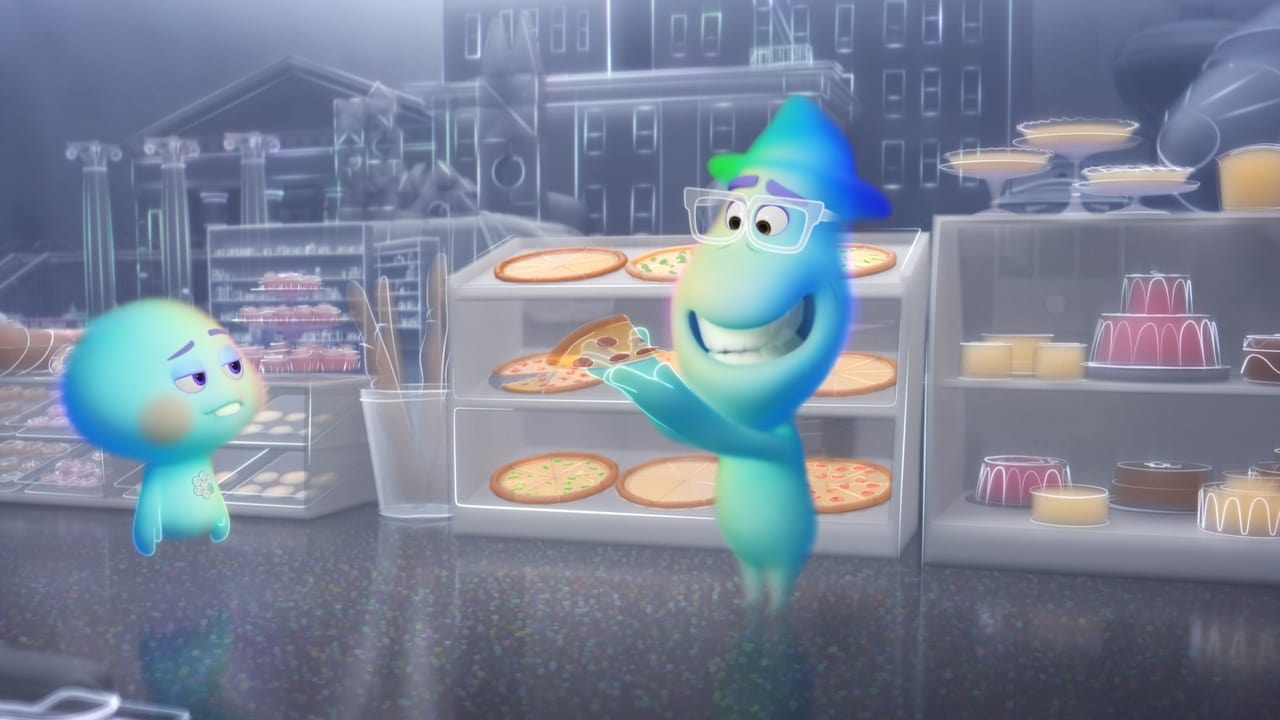
Joe Gardner spends the film certain that his spark, jazz, is the reason he exists. The piano. The gig with Dorothea. The night that will finally prove his life has not been a waiting room.
He is wrong, but not in the way a simpler film would make him wrong.
Soul does not tell Joe that jazz does not matter. It does not mock his gift, flatten his ambition, or punish him for wanting something difficult. The film is too honest for that. Joe's love of music is real. His talent is real. The years of practice matter. The gig matters.
The spark is real.
It is also not the point.
Joe's mistake was never that he had a calling. His mistake was asking the calling to become the verdict on whether his life had been worth living. He took one expression of aliveness and made it responsible for aliveness itself. That is too much weight for any gift to carry.
This is the tension the film keeps open. If you hear only that purpose is a trap, you get a passive reading where ambition is the enemy and the answer is to drift through your days admiring leaves. That is not enough, and a child who takes only that lesson is being shortchanged.
If you hear only that you have a real gift and must not waste it, you get Joe at the beginning of the film. Gifted, disciplined, hungry, and hollowing himself out by needing the gift to justify the life.
The truth is harder and better.
You may have a genuine spark, and it may not be your reason for being.
Both. At once.
Do not resolve it too quickly.
The ocean was never somewhere else
The fish parable is one of the oldest spiritual and philosophical insights dressed in one of the simplest images.
The thing you are straining toward is the thing you are already standing in. The ocean is not a better body of water waiting somewhere ahead. The ocean is the water, seen correctly.
Strip the film down and that is its real subject: being comes first.
Before Joe is a musician, before he is a teacher, before he is a success or a failure, before he is anything a person can put on a business card, he is alive. He is a being having an existence. Everything else is downstream from that. Identity, ambition, craft, role, reputation, dream. These are real. They can be good. They can be worth pursuing. But they are not the ground.
The ground is aliveness.
This is why 22 matters. She is not simply a comic foil or an unborn soul who refuses the assignment. She is a soul before self. No stable personality. No life history. No vocation. No story she can point to and call hers.
And what she discovers in Joe's body is not a purpose.
She discovers readiness.
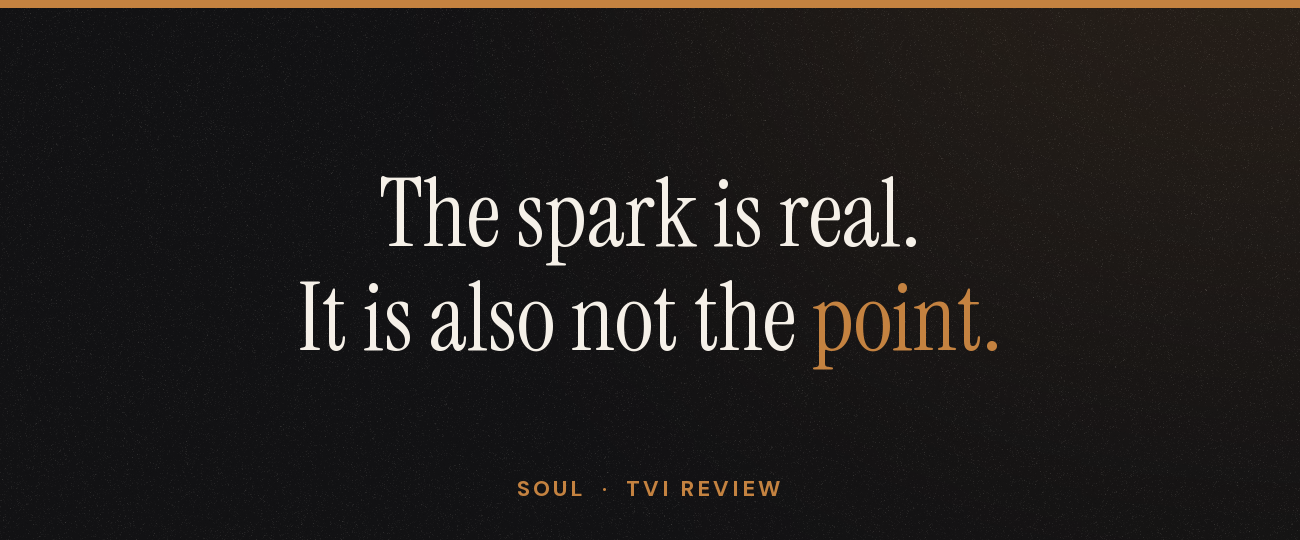
Pizza. Wind. A subway musician. A barber shop. A maple seed spinning down from the sky. She does not discover the career she was meant for. She discovers that life is something she wants to enter.
That discovery is prior to self.
This is why Soul can feel almost uncomfortably moving to adults. Many adults have spent years constructing selves: professional selves, parental selves, gifted selves, wounded selves, useful selves, successful selves, failed selves. Then a film about a jazz musician and a blue soul quietly suggests that the self we worked so hard to build was never the ocean.
It was something moving in the water.
That does not make the self false. It makes the self secondary.
The ocean was there before the self knew how to name it.
The one-degree difference
There is a framework I come back to often: drift.
A one-degree deviation, held over enough distance, becomes a different destination entirely. At first, the difference is almost invisible. Two ships leave the same harbor, one degree apart. For a while, they look like they are traveling together. Then the distance compounds.
The confusion between a calling and a life is exactly one degree.
At twenty-five, the musician who loves music and the musician who needs music to prove he matters may look identical. Same practice schedule. Same hunger. Same gigs. Same language about purpose. From the outside, you may not be able to tell them apart.
Run that one degree over decades, and you get two different people.
One is Joe at the beginning of the film: gifted, disciplined, legitimately called, and hollowed out by the need for the calling to settle the question of his worth. The other is someone who may have done the same work, played the same notes, and stayed connected to his life while doing it.
For that person, the gig becomes an expression of aliveness already present.
For Joe, the gig is asked to make aliveness legitimate.
That is the drift.
I think about this constantly in medicine. The difference between a clinician who is present with a patient and one who is performing presence can be nearly invisible from a distance. Same questions. Same exam. Same chart. Same gestures.
But the patient can often feel the difference immediately. One person is there. The other is doing the shape of being there.
The motions can match while the life inside the motions has gone missing.
Soul is a film about that one-degree difference. It is worth naming for an older child or teenager: there is a difference between loving what you do and needing what you do to tell you that you are worth something.
They can look the same up close.
They are not the same life.
The Zone and the lost souls are the same image
The most brilliant visual idea in Soul is easy to miss because the film does not stop to underline it.
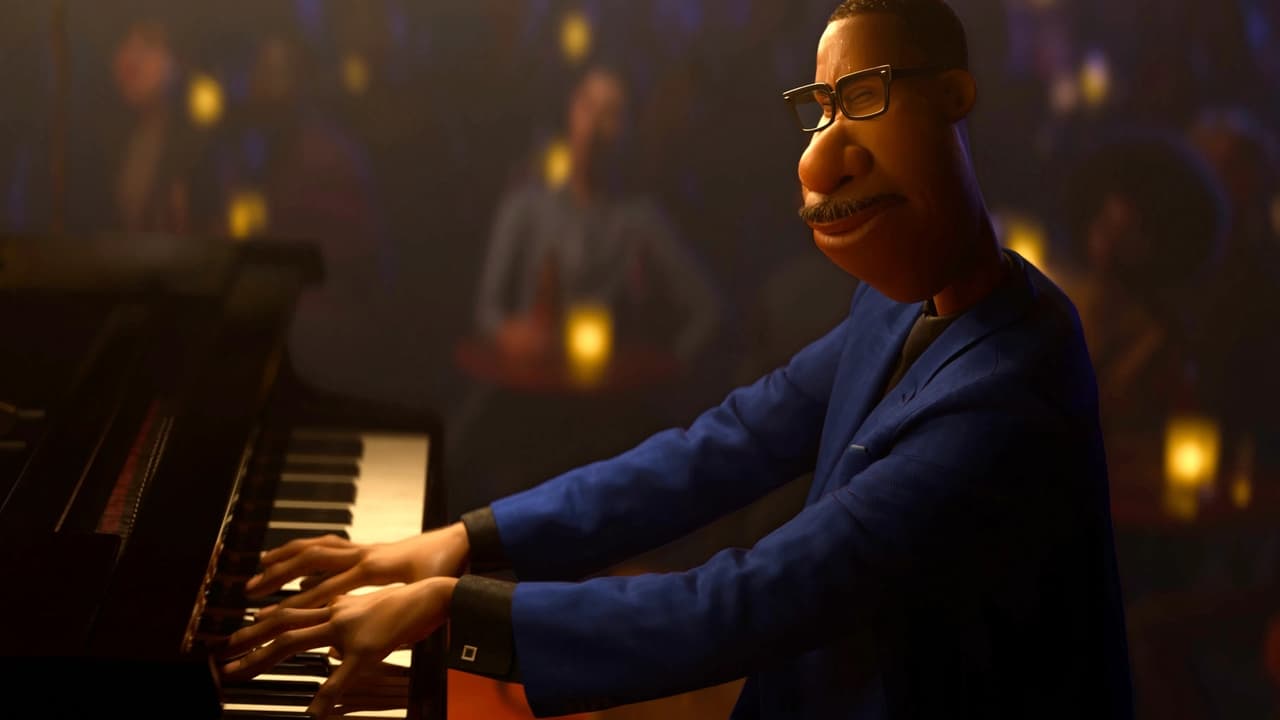
The film shows us the Zone, the blissful territory people enter when they are fully absorbed in a craft. Musicians. Athletes. Performers. Makers. Anyone who loses ordinary self-consciousness inside meaningful work. Joe goes there when he plays, and the film renders the experience as transcendence.
Then the film shows us the lost souls: dark, lumbering, sand-crusted figures wandering in obsessive loops, disconnected from everything around them.
The crucial detail is that the Zone and the lost-soul territory are not opposites.
They are the same place at different intensities.
Joe in flow and a lost soul in fixation occupy the same visual world. The difference is not the gift. The difference is the relationship to the gift.
The thing that lights you up can also drown you.
A spark pursued to the exclusion of living does not remain a spark. It becomes an obsession. It begins to consume the life it was meant to enrich.
This is a profound thing for a film to say to a culture that tells children to find their passion as if passion pursued at all costs were obviously good. Soul knows better. It shows the cost.
A healthy calling stays in conversation with the whole life around it: family, rest, friendship, food, the body, the ordinary day, the person cutting your hair, the student who needs you more than your dream gig does. A calling that stops listening becomes something else. It keeps asking for more. More time. More proof. More sacrifice.
Think of a fire. Held in the hearth, in relation to the house around it, a fire warms everything. It is the center of the home. The same fire, with no walls to hold it and nothing to keep it in relation to anything, consumes whatever it touches and burns the house to the ground. Same flame. The difference is whether it stays in relationship to the structure that sustains it, or whether it begins to feed on it.
A calling can do the same thing to a person.
Held as one expression of a life, the spark becomes the Zone.
Held as the only thing, it becomes the lost soul.
Same gift. Same fire. Different relationship to the whole.
That is one of Soul's deepest insights.
Being seen changes everything
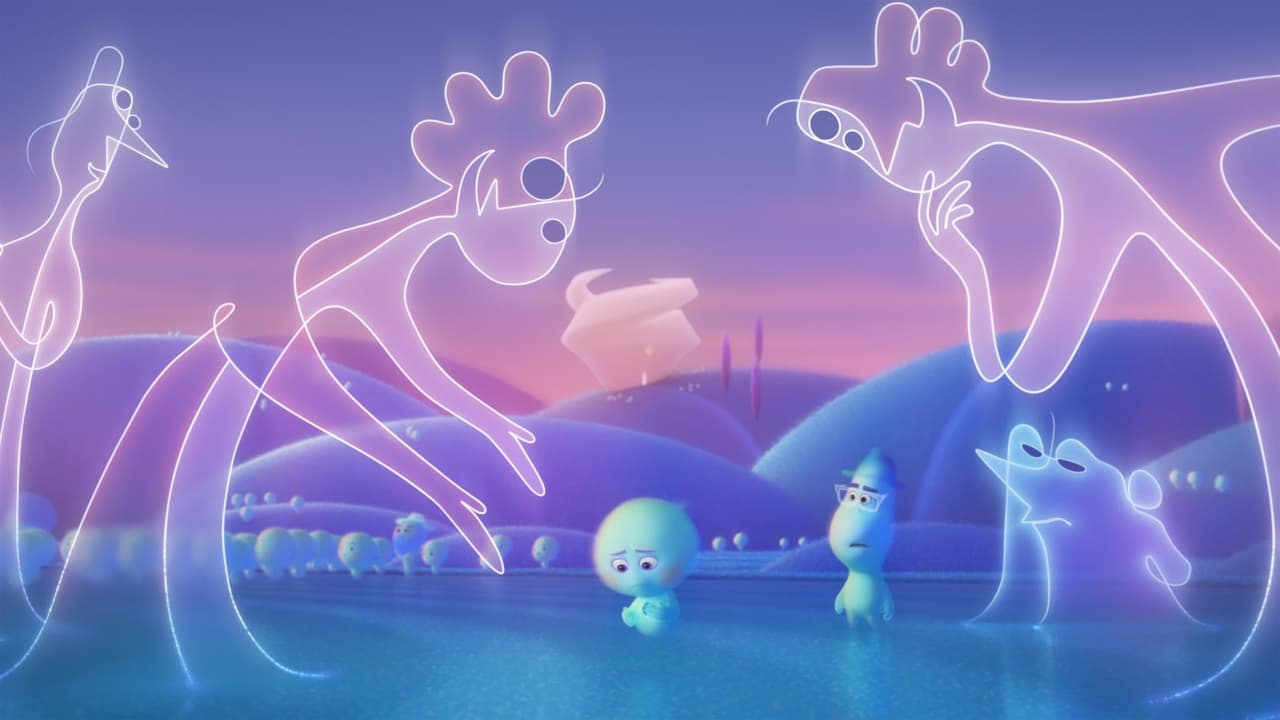
22 is usually described as a soul who cannot find her spark.
That is not quite right.
She is a soul who has decided, in advance, that life is not for her.
There is a difference.
She is not incapable of life. She is defended against it. Her identity has hardened around refusal. Every mentor who failed to reach her has left a mark. Every correction became another layer of armor. By the time Joe meets her, she is not waiting to be inspired. She is waiting to be proven right about her own exception.
Life works for other people.
Not for me.
Anyone who has cared for another person has met some version of 22. A student who has decided school is not for them. A teenager who has decided love is not for them. A patient who has decided health is for other people. A friend who has decided, without ever saying it out loud, that joy is something other people get to have.
The film's answer is not argument.
Nobody debates 22 into readiness. No one gives the speech that fixes everything. What changes her is being met inside an ordinary day, by someone close enough to witness the world alongside her rather than correct her response to it.
That is the film's quiet care ethic.
22 is not broken and then fixed. She is a being who had never been accompanied in a way that let life become desirable. Joe does not save her by explaining purpose. He helps her touch the world, and the world does the rest.
Being seen changes the conditions under which a person can want to live.
That is not a small lesson.
It may be the most important one in the film.

For parents: the real age of access
Soul is rated like family entertainment, but its actual emotional access point is older than its surface suggests.
A young child may watch a colorful adventure where a man becomes a cat and a blue soul learns to like Earth. That is a valid first reading. But the film's deepest material, the fear that your life has not meant what you hoped it would mean, the strange emptiness after getting what you wanted, the difference between a gift and a reason to exist, will pass over many young children.
That does not make the film inappropriate.
It makes it layered.
For younger children, the questions are practical. The film treats death as a premise rather than a concrete event. Joe falls into a manhole, enters a stylized afterlife system, and spends much of the film trying to return to his body. Nobody dies on screen in the way a child might experience Mufasa's death in The Lion King. The Great Beyond is rendered as a soft escalator into light, which may feel gentle for some children and confusing for others.
Some children handle concrete emotion more easily than abstract metaphysics. A child may understand that Joe misses his father more readily than that Joe is resisting the Great Beyond. Know your child. Watch how they respond to the opening. If they ask what happened to Joe, answer plainly and calmly.
For older children and teenagers, Soul becomes much richer. It can open a conversation about gifts, pressure, ambition, disappointment, and the fact that no achievement can do the work of making a person worthy.
The best age of access is not simply chronological. It depends on what question the child is ready to ask.
A six-year-old may ask why he is a cat.
A twelve-year-old may ask what their spark is.
A sixteen-year-old may need to hear that their spark matters, but it is not the whole reason they are here.
The same film can meet each child differently.
That is not a flaw. That is the film doing layered work.
The seam the film does not close
A serious review of Soul has to name one real tension in how it handles representation. It starts with something easy to take for granted.
Joe Gardner is Pixar's first Black lead. The scenes of his life in New York are some of the most alive material the studio has ever animated: the barber shop, the tailor shop, the music, the texture of neighborhood and craft and embodied specificity. Those scenes matter because Joe is not an abstract soul. He is this person, in this body, from this world, shaped by this music, this mother, this city, this cultural inheritance.
And yet the film spends a large portion of its runtime separating him from that body.
First he becomes a formless soul. Then he becomes a cat. During one of the most important stretches on Earth, 22, voiced by a white actor, moves through the world in Joe's body while Joe watches from outside it.
That choice is not incidental. It is part of a pattern critics have named before, especially in animation: the first Black character to carry a historic representational burden is transformed into something nonhuman for much of the story. The comparison to The Princess and the Frog is difficult to avoid.
This does not erase the warmth, beauty, or specificity of Soul. It does not mean the film is cynical. It does not mean viewers who felt seen by it were wrong. It does mean the film's universal spiritual premise, that souls are prior to race and body and identity, sits uneasily beside the fact that the film is most alive when it attends to Joe's particular embodied world.
The universality the film reaches for can flatten the specificity that makes it sing.
This is not the only thing the film leaves unfinished, and it is not the whole of what the film gets wrong. But it is the seam most worth naming, because it sits closest to the film's central claim. It should stay visible.
The right response is not to dismiss the film or defend it past the point of honesty. The right response is to watch with both eyes open. Soul reaches for something profound about being prior to identity, and it sometimes undercuts the very identity that gives its Earth scenes their force.
Both are true.
A viewer can love the film and still name the misstep. A parent can admire what the film offers and still teach a child that beloved things are not beyond question.
That is not cynicism.
That is better attention.
What is true
So is Soul a masterpiece?
Almost. And it is closer in its images than in its words.
The film reaches for one of the oldest and most difficult questions a person can ask: what is a life for? Then it offers a more unsettling possibility: maybe the question itself is wrong. Maybe life was never for something outside itself. Maybe the ocean was the water all along.
That is why Joe's final lesson cannot simply be to enjoy the little things. That phrase is too small for what the film means. The little things are not decorations around the real life. They are the life. The gig, the career, the praise, the achievement, the dream: these are meaningful only when they remain connected to the aliveness underneath them.
The spark is real, and the spark is not the point.
The calling matters, and the calling is not the life.
Achievement comes and goes, and it cannot carry the weight we hang on it. Not because achievement is empty, but because achievement was never built to be the source of meaning. It was built to be an expression of meaning already present.
Joe spends the film trying to get back to his life, and then he learns that his life was not waiting at the gig. It was the ordinary day he had been treating as the hallway before the room.
There was no hallway.
There was only the room.
When we are present, we are connected to our own life. When we are connected to our life, we are connected to the people in it. That is the water. That is the ocean.
You do not have to go find it.
You are in it.
Look around.