THE ODYSSEY (2026), REVIEWED ON THE PUBLISHED METHODOLOGY
What the Horse Broke
The Trojan Horse did more than breach Troy. It weaponized trust. Christopher Nolan's The Odyssey follows the damage through monsters, marriage, kingship, and memory.
183/ 200Masterclass
By Jordan Robinson, MD, MPH, TV Intelligentsia July 19, 2026 · Two theatrical viewings · 14 min read
The Odyssey (2026), Universal Pictures. Used for review.
New here? The sixty-second version
The Trojan Horse did not only breach Troy. It taught the world that a gift can be a weapon, and Nolan spends three hours following that lesson home.
183/ 200 · Masterclass
Sixty-five titles sit above it among the 2,608 films and series scored on the published TVI methodology, which puts The Odyssey in the top 2.5% of the catalog. It ties The Wire and lands five points short of Oppenheimer. Craft and Quality scored 49 of 50, the part of the rubric the film comes closest to maxing.
Odysseus wins the war by turning a sacred offering into a delivery system for slaughter. What the trick breaks is larger than a city. It breaks the rule that a stranger at your door is owed shelter before he is asked his name, and without that rule travel becomes predation.
Everything after is the afterlife of that act. The monsters are not the point. Each encounter tests the same human faculties, cunning, patience, restraint, and the judgment of a man responsible for other lives, against conditions built to overwhelm exactly those faculties. Odysseus has no powers here. He has a mind, and the film is honest about what using it costs him and the men who followed him.
The last act is not a victory lap. It asks whether surviving a war has made a man worthy of the home that waited for him. That question, not the Cyclops, is what the three hours are for.
Not ready for fourteen minutes? Take the one-page field guide instead: the horse, the loom, the rooted bed, the return, and five questions to ask whoever you see it with.
Full spoilers follow. This essay discusses the ending and the architecture that makes it work.
Scoring note. This is an informed post-discussion score entered after both screenings, not a blind score. Cordelia Witty attended both viewings, reviewed the final assessment, and agrees with the score.
Christopher Nolan's The Odyssey begins with a victory that teaches the world not to trust. The Trojan Horse does more than breach Troy. It weaponizes the gift itself. Everything that follows, from the Cyclops's cave to Odysseus's own hall, is the afterlife of that act.
After two theatrical viewings, one standard and one 70mm IMAX, TV Intelligentsia scores The Odyssey 183 out of 200: Cognitive Stimulation 46, Educational Value 43, and Craft and Quality 49. That places it in the Masterclass tier. On the live catalog that ties The Wire, sits above The Godfather, and lands five points shy of Oppenheimer.
Official trailer
See the world before it breaks
Official new trailer, Universal Pictures. Embedded for review.
The Odyssey is a film I had to see twice. The first viewing overwhelmed me. The second convinced me. Scenes I had taken as texture became setups. Lines I had passed over returned as load-bearing. The fractured chronology, which begins in medias res as the poem does, does not merely rearrange events. It arranges them by moral resonance, letting a promise made before the war answer a failure years later. That is the test I trust most. A film can fool you once on spectacle. It cannot fool you twice on structure.
What makes the film epic is not the size of its monsters. It is how much of a human being the journey requires. Odysseus survives through wit, endurance, deception, restraint, memory, command, and finally surrender. The ordeals are superhuman. The instruments are human.
That human journey sits inside a larger collapse. The Horse's damage moves outward and inward at once. It breaks the covenant that makes strangers safe, passes its cost down the social order, and follows the victors home inside themselves. The film spends the rest of its running time asking what, if anything, can still be carried across the break.
A film can fool you once on spectacle. It cannot fool you twice on structure.
I
The code that holds the world
The engine of the film is not a monster. It is a rule. Zeus's law, the code of hospitality that runs through every scene, says the stranger at your door is owed shelter and protection before he is even asked his name, because he may be more than he appears. Without that law, travel becomes predation, trade becomes exposure, and diplomacy becomes impossible. Nolan stages the rule the way an engineer stages a load test: here is what it protects, here is what happens as it fails, and already, from other shores, a rumor of people from the sea. A palace, one character observes, is nothing without respect for what it means.
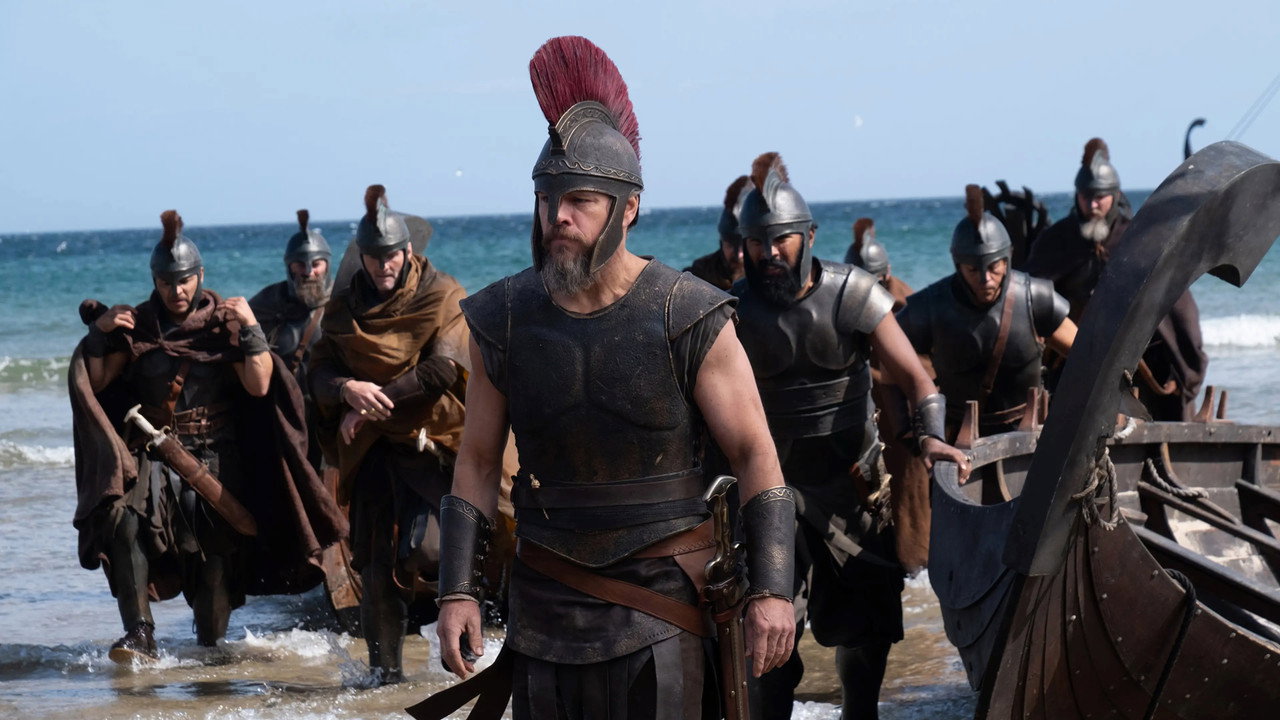
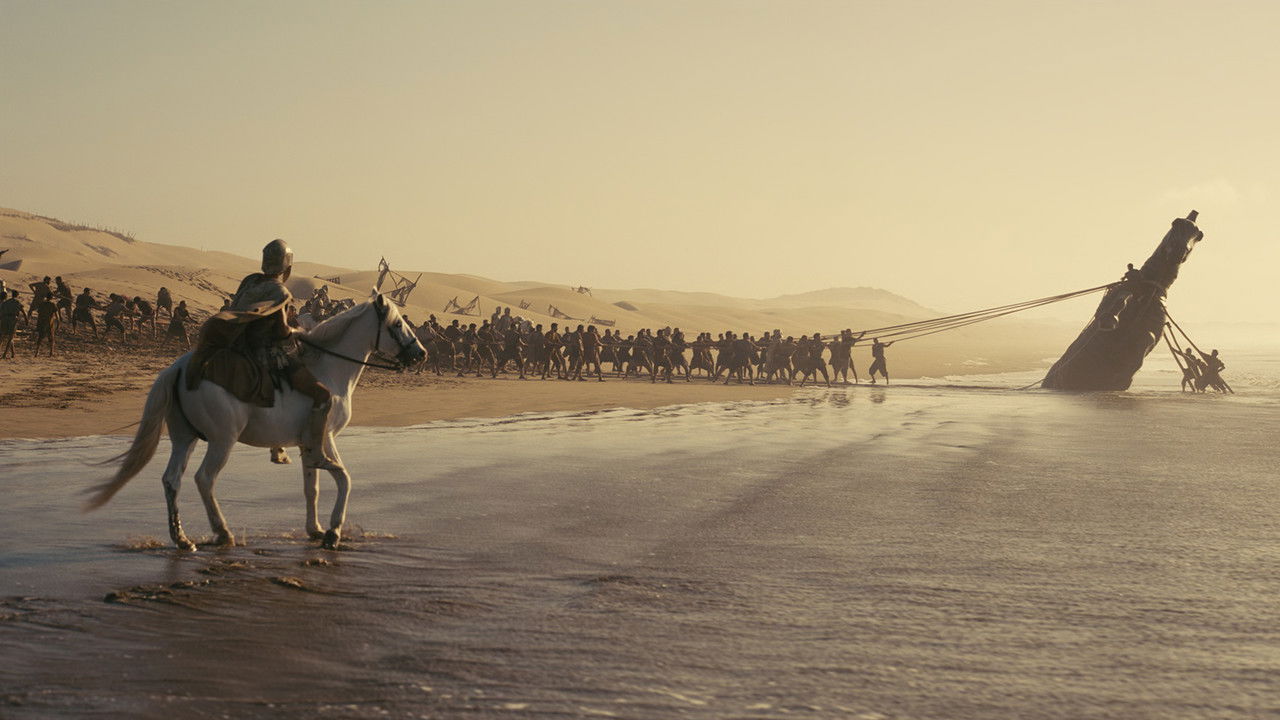
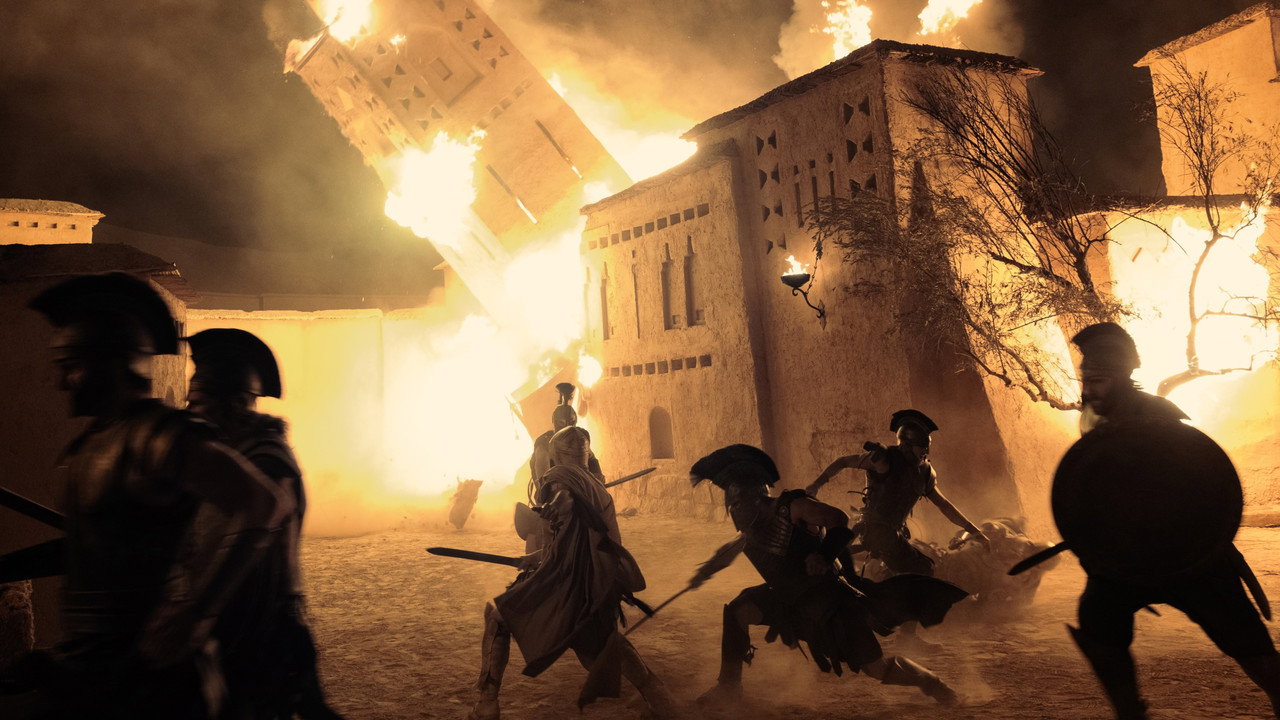
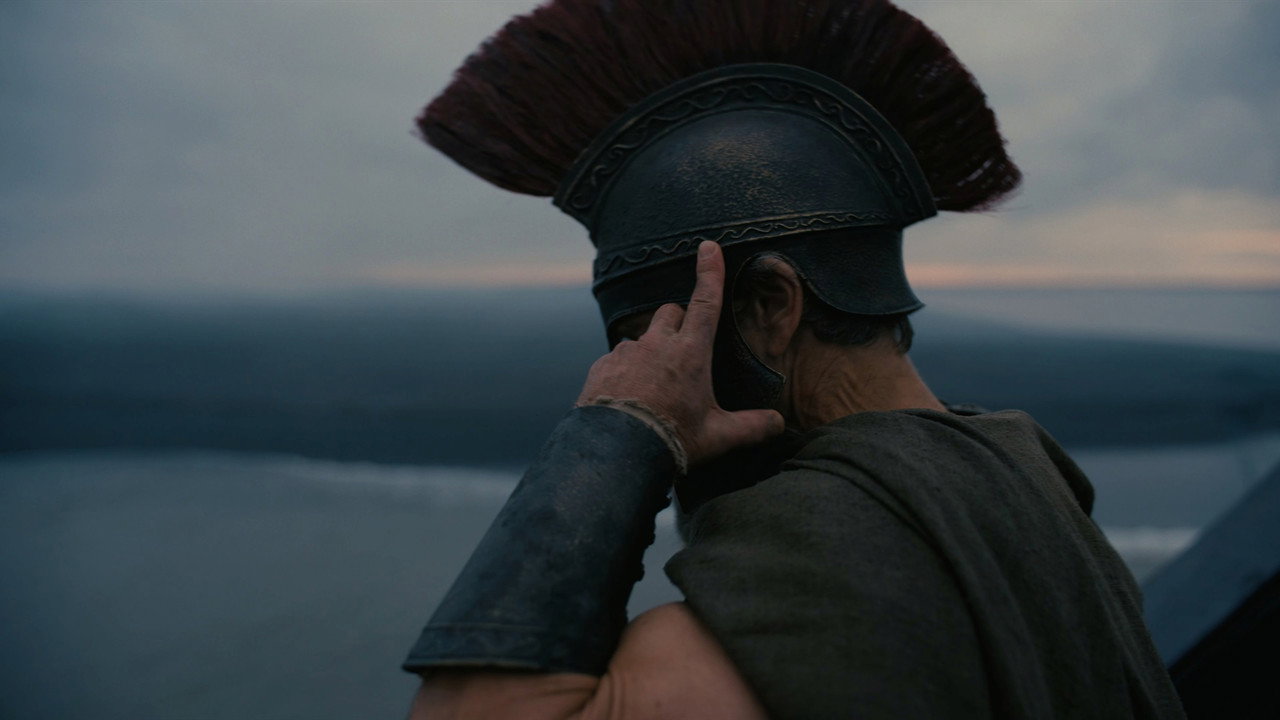
At the film's center of gravity sits the act that corrupts the rule: the Trojan Horse. A sacred offering, built to be received in good faith, becomes a delivery system for slaughter. Nolan's Troy is not a triumph sequence. It is a crime scene revisited, ten years of rage poured into a city through the front gate its own piety opened.
Odysseus authors the trick, and the film gives his guilt a face. The Athena who visits him wears the likeness of a priestess of Athena, a young woman killed by the Greeks in the sack of Troy, so the goddess of wisdom and a victim of the victory arrive as one presence. She is the conscience he cannot out-argue, because his own war supplied its face. From that point forward, the wanderings stop reading as bad luck. They are the interior afterlife of the victory.
Then the film turns the doctrine over. The old teaching says to honor the stranger because the stranger may be a god in disguise. But the gods are not the ones being tested. We are. The law exists because human beings are the ones capable of keeping it, and the ones whose world collapses when they do not.
The Odyssey (2026), dir. Christopher Nolan. Universal Pictures. Used for review.
II
Who paid for the Horse
Once trust becomes a weapon, the next question is who pays.
Before the film shows what the war cost, it shows how the war was purchased. A king coerces a father: sail, or lose your son. The coercion moves downward through a levy drawn by lot. A wealthy family buys a substitute for its chosen son, and a shepherd's boy dies at Troy carrying another man's obligation. Twenty years later, the men feasting in Odysseus's hall are the generation that did not go. The occupation of Ithaca is not random villainy. It is the class that dodged the bill living in the house of the man who paid it.
That is the film's cold answer to why the war happened. Helen remains at the edge of the frame. Troy's control of the trade routes is the colder motive. Empire wears honor as a costume, then passes every cost to someone with less power to refuse.
The Odyssey (2026), dir. Christopher Nolan. Universal Pictures. Used for review.
III
The world after trust
The cost does not stay political. It moves inside the men who return.
War, the film argues, is a sacrifice in the exact and terrible sense: you trade your gentleness for ruthlessness, and the trade works, and that is what makes it monstrous. The monsters are consequence, not creatures; the form of each reflects an interior reality. They kill bodies, but broken trust is what makes the world unlivable.
The Cyclops is the law's absence made flesh, a host who eats his guests. Nolan makes one revision that is easy to misread. In Homer, Odysseus escapes and shouts his own name at the blinded giant, buying a god's hatred with a boast. Here he says nothing and fires a single arrow back for his dead. It would be comforting to call that growth. It is not, quite. Nolan removes the boast but not the pride. Vanity becomes vengeance, and the curse still finds its address. The sea will spend ten years collecting interest.
The prophecy scene offers the film's coldest account of leadership under unavoidable loss. Odysseus is told the price of the passage in advance: choose the whirlpool and lose everyone, or choose the cliffs and lose six. He chooses, conceals the arithmetic, and absorbs the mutiny that follows. The film refuses to absolve him. It also refuses to invent a clean option that was never there. That is command, rendered without anesthesia.
The alternative to a terrible decision was not a good one. It was a worse one.
The Circe sequence treats magic less as creation than disclosure. Samantha Morton's Circe does not invent appetite. She makes visible what war has licensed. The men arrive as hunger wearing armor, and her sorcery gives that appetite the body it had already earned. Her own violated trust has sharpened perception into indiscriminate defense. When she restores them, their human bodies feel like the new disguise.
The Sirens do not simply offer pleasure. Their song is compulsion after pleasure has stopped satisfying: every promise you failed to keep singing back, the thing most desired because it has already been lost. The song tells Odysseus something worse, that part of him does not want to go home because home would require him to remember who failed it.
The cattle episode is the same failure at crew scale. The men know the boundary; starvation gives appetite a moral argument. By the time they slaughter the herd, the act is not a surprise but the unveiled form of what they had already been asking permission to do. The island has its own physics of captivity: the wind that makes it easy to enter becomes the force that makes it impossible to leave.
The Odyssey (2026), dir. Christopher Nolan. Universal Pictures. Used for review.
IV
The two suspended clocks
While Odysseus loses the promise in memory, Penelope keeps it alive in practice.
The film's structural masterstroke is a marriage running the same experiment from opposite ends. On Calypso's island, Odysseus forgets his life, night after night, in a captivity indistinguishable from comfort. On Ithaca, Penelope weaves a burial shroud by day and unweaves it by night, undoing the ending everyone demands she accept.
He suspends memory. She suspends time.
His task is to recover the life pain made him abandon. Hers is to preserve the possibility of return without surrendering the house to the men consuming it. Nolan cuts between their suspensions until the marriage feels less like waiting than two forms of resistance operating across distance. Neither lets go.
The Odyssey (2026), dir. Christopher Nolan. Universal Pictures. Used for review.
V
The house he comes home to
The journey's final monster is a household where the covenant no longer operates. The homecoming is where the Horse's damage becomes visible at domestic scale.
Odysseus returns to an unrecognizable home with loyalties he cannot know. He enters his own house as a beggar because the clearest view of power is from below. By withholding his name, he sees the house without the distortions of rank.
But look harder at why the disguise works, because this is the film's sharpest irony, and it closes the loop the Horse opened. Zeus's law commands that every stranger be received as if he might be a god. In a hall that kept the law, a beggar would be the worst possible disguise. He would be fed, questioned, watched, and seen.
The disguise is perfect only because the code is already dead in that room.
Troy falls because it still believes a gift can be sacred. The suitors fall because they no longer believe a stranger can be. The Horse enters through trust. Odysseus enters through the absence it leaves. The suitors even joke that this wretch is certainly no god. Their contempt is both the crime and the blind spot. The lack of regard that unmakes a civilization is the same lack of regard that gets these men killed, and the film lets the justice execute itself.
The house he audits is not a house that waited. It is a house that was governed.
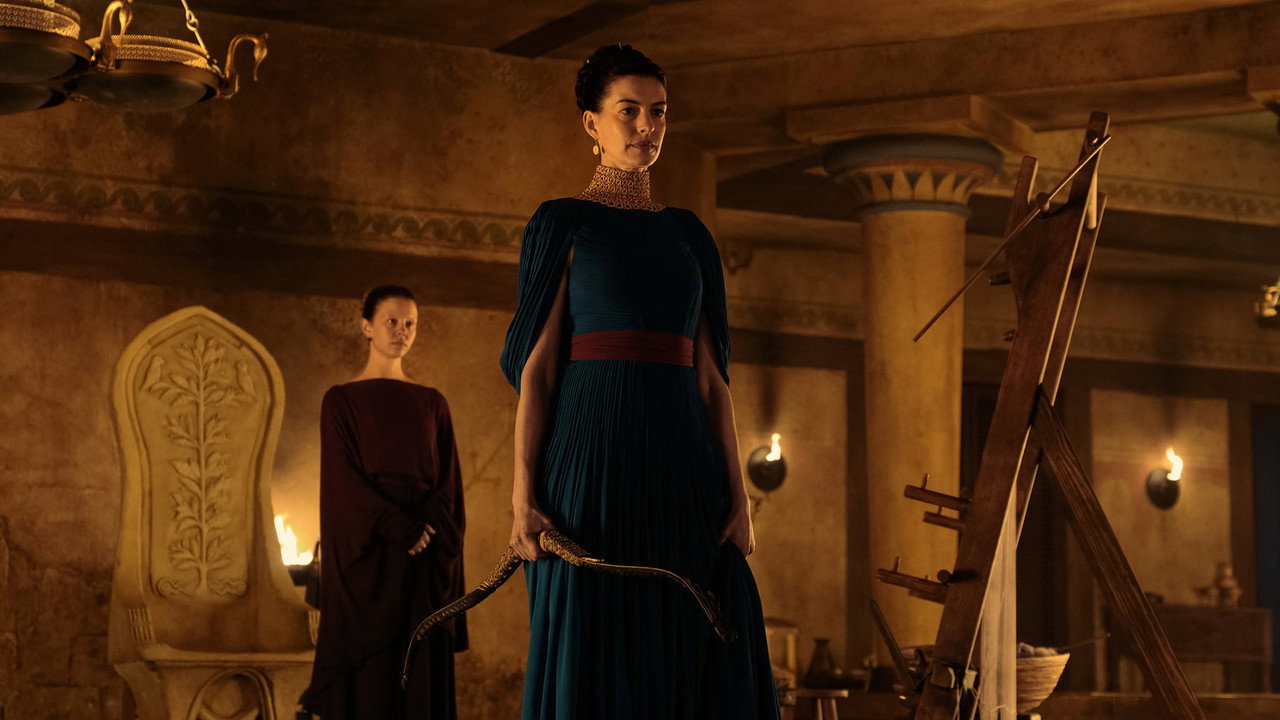
The film's Penelope has ruled Ithaca for twenty years. When the men around her speak of the empty throne, she names the fiction aloud: the throne has not been empty. She preserves enough order for return to remain possible, then decides, on her own timing, when preservation must become strategy. She calls the trial. She sets its terms. She has the weapons removed from the hall. The reunion Nolan builds is not a rescue. It is coordination between two intelligences that have been working on different fronts.
The trial of the bow is the film's theory of rightful power, and it is more than strength. The strongest suitor cannot string it. Odysseus can, and the film has spent two hours defining him: strength, guile, patience, restraint, wisdom. He plucks the string before he hunts, warning the prey before an act of stealth, and the pluck returns before the reckoning.
The bow does not prove that kingship is a mystical substance only one man can possess. Telemachus is becoming capable of carrying the house. Capability can be inherited. Debt cannot. The son may receive the throne, but the father must settle the account that made the reckoning necessary.
The Odyssey (2026), dir. Christopher Nolan. Universal Pictures. Used for review.
The disguise is perfect only because the code is already dead in that room.
The rumor running beneath the entire story, the people from the sea, the raiders unmaking the world, resolves in a conversation between Penelope and Odysseus. The feared people from the sea are homecoming Greeks, displaced victors, and raiders seen from someone else's shore. The heroes of this story are the monsters of everyone else's. Nolan lets Odysseus take that recognition full in the face.
Late in the film, Odysseus names the crime beneath the others. The fragile bonds between men, the ones everything else stood on, were broken. The breaking was theirs. The world does not end because monsters arrive. It ends because the agreements that made it livable stop being kept.
I have thought about that admission more than any single image in the film.
The sea is the film's most honest symbol because it refuses to be one thing. It punishes them and saves them, over and over. It is the route home and the medium of the raid, their curse and their salvation, the surface across which stories about them travel faster than they do. The sea is consequence. It keeps them alive exactly long enough to become what everyone fears.
That coherence has a cost, and any admiration worth publishing should survive the strongest case against it.
Richard Brody's strongest objection, in The New Yorker, is that Nolan renders Homer morally legible by stripping away much of the ancient world's divine ambience, ritual strangeness, caprice, and cruelty, leaving what he calls a "purely human drama" where the poem had gods in every moment. He is right about the size of that trade. Nolan turns gods into absences, ritual into psychology, divine caprice into human responsibility, and a many-sided trickster into a largely continuous line of guilt and remorse. The result is morally coherent and emotionally forceful, but less strange than Homer: less funny, less erotic, less capricious, less willing to leave cruelty unexplained.
The clearest measure of that trade is what happens to Homer's rooted bed. The film preserves the Horse as craft used to destroy covenant and the loom as craft used to preserve it, but not the bed as the poem's final instrument of mutual recognition, the object Odysseus and Penelope made together and no outsider can move. Nolan leaves covenant primarily as a moral choice where Homer made it physical, private, and mutually knowable.
Nolan does not preserve the poem whole. He forms a legible modern argument from it. The greatness of the film lies not in absolute fidelity, but in the discipline, force, and depth of what it chooses to make visible.
The Odyssey (2026), dir. Christopher Nolan. Universal Pictures. Used for review.
VIII
The film remembers what Odysseus cannot
Nolan's images make human beings small against sea, stone, and sky while the story insists that their promises remain load-bearing. The structure operates as thematic montage, one moment completing another before the plot has formally connected them, so that a lesson about guile can frame both the trick at Troy and the return to Ithaca.
The sound design carries the same argument in another register. The sonic signature of Troy's sack returns when the dead rise in Hades, the noise of victory replayed as haunting, the same sound meaning triumph the first time and accusation the second. The score primes meaning before the image is ready to disclose it. At the bow trial, the pluck of the string lands as the next note the music has been reaching for, weapon and instrument fusing in a single sound. The 70mm IMAX proved additive, not essential; the full verdict is in the format guide.
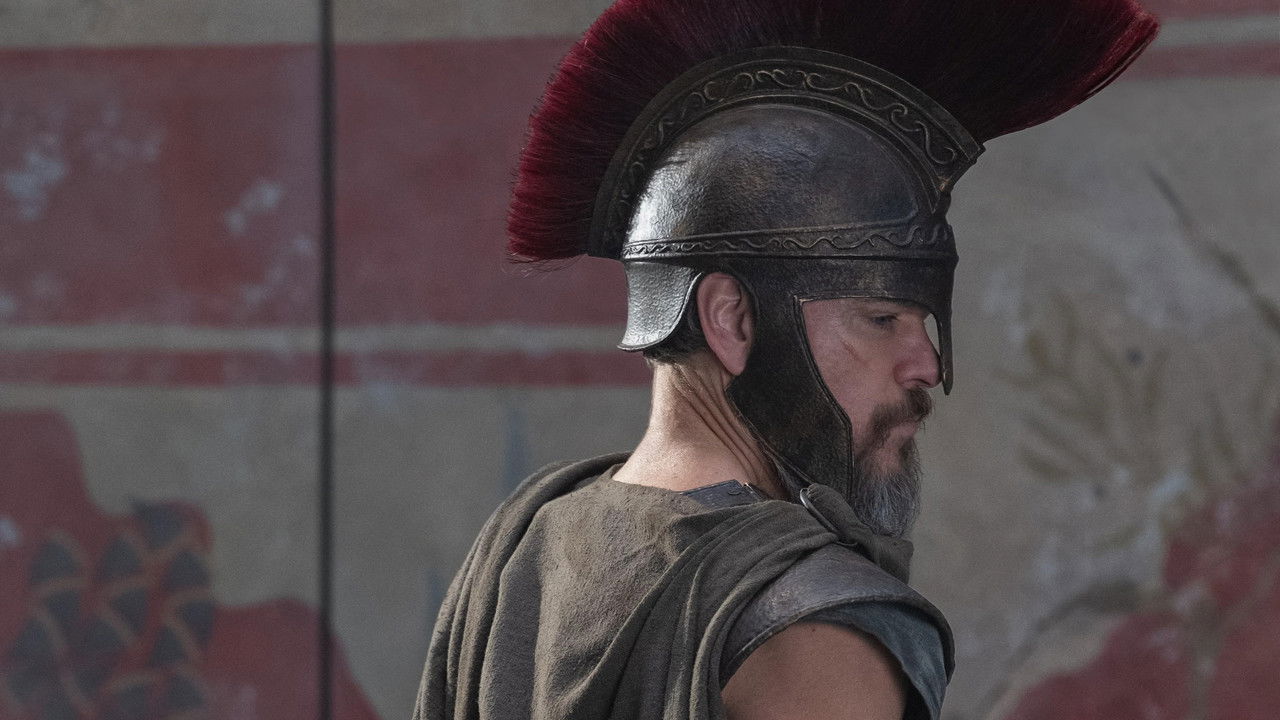
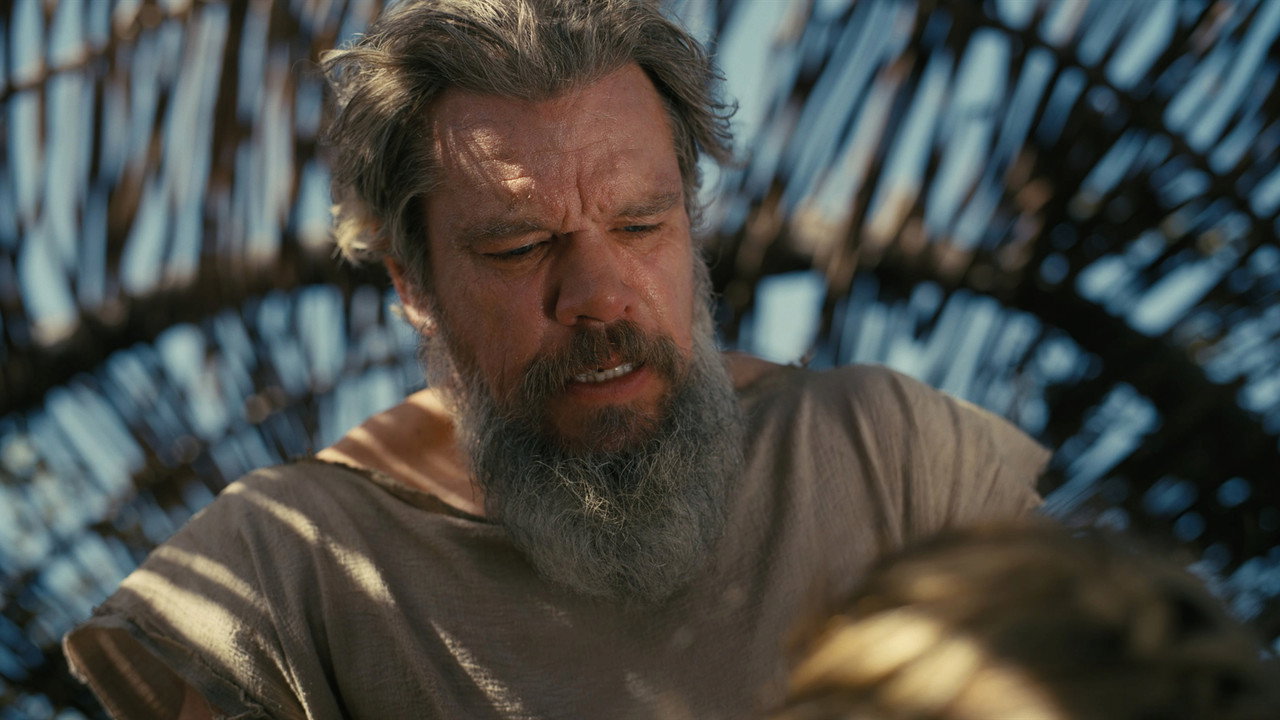
Matt Damon plays Odysseus as a man whose cleverness has stopped feeling like a gift. Anne Hathaway communicates governance rather than waiting; Nolan photographs Penelope like the administrator of a siege, which is what she is. Robert Pattinson's Antinous is precision casting, the exact type who mistakes another man's absence for his own opportunity, and the film gives him one lie about the war that the ending returns with interest.
After two viewings, I could not name the weak frame.
That is why the film's scale never feels merely large. It gives ordinary moral experiences the size they possess from inside: a decision whose cost falls on someone else, a home that continued in your absence, a promise kept without proof, a room in which everyone knows your name and no one sees you. Under the bronze, these are not ancient problems. They are ours.
The Odyssey (2026), dir. Christopher Nolan. Universal Pictures. Used for review.
IX
The war ends before the warrior does
I sat through the credits both times, and not out of habit. By the second viewing, the ending was impossible to mistake.
Odysseus returns. He restores his house. And he does not stay to enjoy it.
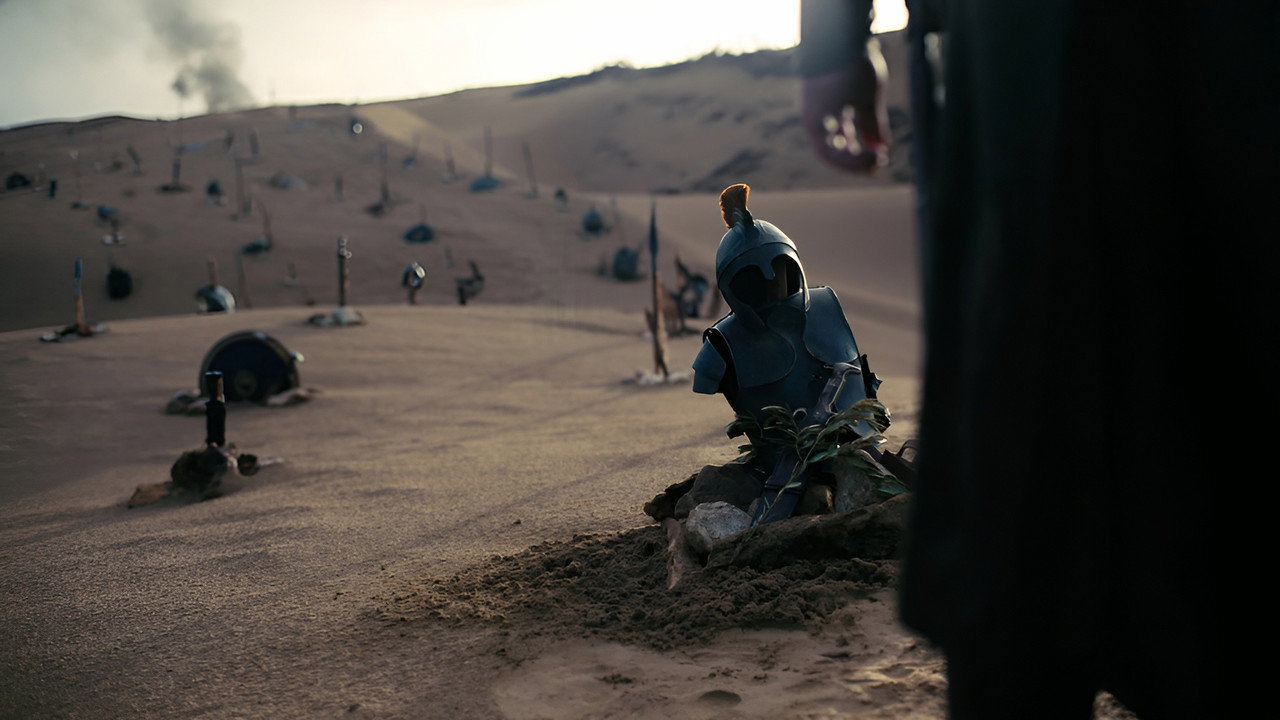
He does not reclaim the throne. He and Penelope sail west together to honor the dead he owes, while Telemachus inherits Ithaca, a kingdom still under repair inside a civilization already going dark. The ending is not a father abandoning a broken world to his son. It is a marriage choosing restitution over possession, and a son receiving the crown along with the truth about what it cost. Odysseus leaves knowing the dark is coming. That is not despair. It is a warning, delivered in the only form warnings reliably survive.
The film's mythic world stands at the edge of the Late Bronze Age collapse, when a connected world of palaces, records, and Mediterranean trade came apart. The Homeric poems took shape centuries later through an evolving oral tradition, carrying patterns of a world that had already disappeared. Song carried enough of that lost order forward for later people to remember, revise, and judge it.
That is the film's final claim about itself, and it is the truest one. A story is not merely an example of a rule. It is a system for thinking when the rules run out. You cannot write an instruction for every situation a human being will face, but you can tell a story that installs the pattern. This one has been doing so for nearly three millennia. It is still alive enough to argue with us.
A story is not merely an example of a rule. It is a system for thinking when the rules run out.
The question was never whether Odysseus could make it home. It is whether the man who returned could still deserve the home that waited for him. The film does not leave that test in Ithaca.
Be worthy of what you come home to.
The Odyssey (2026), dir. Christopher Nolan. Universal Pictures. Used for review.
Field note
For parents: the real age of access
The film is rated R for violence and some language, and the rating is earned by sustained close combat, the sack of Troy, the Cyclops's cave, deaths at sea, and the slaughter in Odysseus's hall. The realistic age of access is mid-teens and up, ideally with an adult nearby, for a viewer ready for nearly three hours of physical and moral intensity.
A student may already know the story from school, but knowing what happens is not the same as being ready to see it rendered at this scale. For a mature teenager, the most useful co-viewing question is the one the film carries home: What does a person owe the place and people they return to after war has changed them?
What is Christopher Nolan's The Odyssey really about?
The film is about what follows when war weaponizes trust. Odysseus can win Troy and survive the voyage, but homecoming tests whether survival has made him worthy of the promise that waited for him.
What is The Odyssey's TVI Score?
TV Intelligentsia scores The Odyssey 183 out of 200, Masterclass: Cognitive Stimulation 46, Educational Value 43, and Craft and Quality 49. The score was recorded after two theatrical viewings as an informed post-discussion assessment.
Who are the people from the sea in the film?
The film's moral answer is that they are the returning Greeks themselves, victors of Troy seen from someone else's shore. That is the film's interpretation, not a settled historical identification of the Bronze Age Sea Peoples.
How is Nolan's film different from Homer's poem?
Nolan reduces much of the poem's divine strangeness and builds a more continuous human argument around guilt, responsibility, and restitution. The result is morally coherent and emotionally forceful, but deliberately less capricious than Homer.
Is The Odyssey appropriate for teenagers?
It is rated R for violence and some language. TVI's real age of access is mid-teens and up with an adult nearby, particularly for a mature student who already knows the poem and is ready for sustained close combat and nearly three hours of intensity.
What does the ending of The Odyssey mean?
The ending separates return from possession. Odysseus restores the house but leaves with Penelope to honor the dead he owes, while Telemachus inherits a damaged kingdom. Homecoming becomes restitution: getting back is not the same as becoming worthy of what waited.
Is Odysseus the real monster in Nolan's The Odyssey?
The film refuses that simple verdict. Odysseus is both the intelligence that survives the broken world and one of the victors who helped break it. The people from the sea reveal makes the returning Greeks heroic from home and monstrous from someone else's shore.
Jordan Robinson, MD, MPH, is a board-certified general surgeon and plastic surgery fellow. He is a U.S. Navy officer in the Individual Ready Reserve and will return to active duty following fellowship. He writes about film and television through the lens of medicine, military service, and decision-making under uncertainty. Views expressed are his own and do not reflect the official position of the U.S. Navy or the Department of Defense.
About TV Intelligentsia
TV Intelligentsia is the credibility layer for what to watch. We score films and television on a public methodology grounded in cognitive science, developmental psychology, and media-effects research. Editorial scores are not for sale.
The Odyssey (2026), directed by Christopher Nolan. Universal Pictures. 172 minutes. Scored under TVI methodology v1.3.1 after two theatrical viewings, standard and 70mm IMAX. The 183 out of 200 is an informed post-discussion assessment reviewed and agreed by Cordelia Witty. The dimensional breakdown appears on the title page, which carries the legacy label pending re-verification under the current standard; the scoring note above is this review's viewing-and-approval record. The format comparison, story primer, and companion essays complete the series.
TV IntelligentsiaThe Odyssey Field Notes
Questions to Carry Home
What the horse broke, and what homecoming requires
TVI's reading: the Trojan Horse weaponizes trust. The voyage is the afterlife of that act, and the return asks whether survival has made Odysseus worthy of the promise that waited.
What did the Trojan Horse break besides the walls of Troy?
When does Odysseus's intelligence become wisdom, and when is it only a more effective weapon?
Is Penelope waiting for Odysseus, governing Ithaca, or doing something more difficult than either?
Who are the people from the sea when the story is told from another shore?
What does Odysseus owe the home he returns to, and does the ending let him pay it?