Your Mother Your Mother Your Mother Finds Its Way Home
Bassam Tariq's film about a widowed hitman earns a moving ending, though its characters are less fully realized than the story that eventually brings them together.
First impression, written before scoring. TVI has since scored the film under the published methodology: 113/200, Competent. Scores are not for sale.
Contains discussion of the ending.
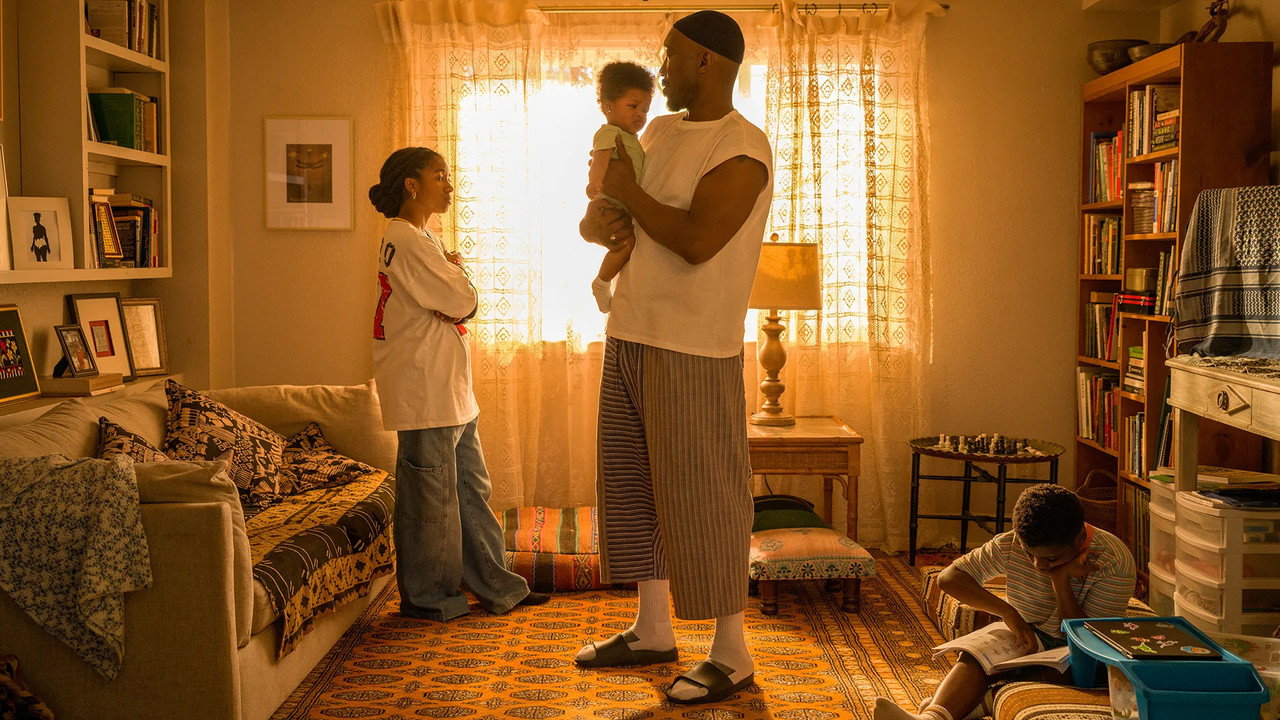
In Your Mother Your Mother Your Mother, writer-director Bassam Tariq gives Mahershala Ali a man whose life is difficult to reconcile even before grief makes it overwhelming. Latif is a Muslim, a father, and a hitman. When his wife dies, the work she did at home falls to him: children to feed, meals to make, and a household that will not wait for him to grieve. He has always thought of himself as the one who protects the family. He has never been the one who feeds it.
His wife's death sends him across Houston trying to provide for his children while the violence of his other life follows him home. The most immediate problem is breast milk. The supply his wife left behind is running out, and their baby cannot keep formula down. It is an unusual objective for an action film, but an effective one: concrete, urgent, and indifferent to whatever authority he thinks he possesses. His baby daughter needs to eat. The film makes that need convincing before letting it lead him into increasingly dangerous company.
There is humor in the distance between Latif's image of himself and the household he is struggling to manage. His son is discovering an interest in women, and his children's private worlds keep expanding beyond his supervision. The jokes are occasionally funny and usually feel appropriate to the moment. They sit alongside the grief without undercutting it.
For much of the first half, though, I was waiting for the film's unusual premise to become something more compelling to watch. Its encounters are populated by eccentric people, but eccentricity alone does not make their company interesting. The story keeps adding eccentric encounters when it would do more to make us care about the people already in it.
Latif is the most consequential example. His circumstances invite sympathy immediately; his character develops less persuasively. The screenplay does offer explanations for his violence. He understands himself as protecting his community and answering wrongs that others have allowed to go unpunished. His religious mentor challenges that account, asking whether money also had something to do with it. His faith supplies the language through which he understands duty, argues with his children, and confronts his wife's death. The contradiction is present, and the film knows it is a contradiction. What remains less convincing is the inner life that allows Latif to inhabit it.

The family is more persuasive in small domestic moments. A scene of hair braiding gives their intimacy a particular, ordinary shape and lets them exist as people who share a life, rather than as the bereaved dependents of an embattled protagonist. The film would benefit from more of that specificity, especially in its account of the mother. Images and recollections establish that she is loved and missed but leave her comparatively indistinct. We understand how much the family needs her more clearly than we understand who she was.
The film opens with a saying in which a man asks the Prophet who deserves his best. The answer is his mother, repeated three times before his father is named. At first the words simply give the title its source. By the closing movement they have acquired a meaning particular to this family. The search for milk has made one part of the mother's absence painfully concrete, and the rest of the film has shown how much more remains beyond that practical need. In that sense, the film is Latif's mourning. He keeps trying to fill the space his wife left, and slowly learns what losing her means for him and for their children, including that the space cannot be filled.
The action climax is one of the film's most visually assured passages, and one I wanted to last longer. Its setup makes that difficult. Latif literally brings a knife to a gunfight; in this case, a sword. There is exciting movement and striking imagery, but the confrontation imposes its own awkward limit: prolonging it would strain credibility, and cutting it short curtails one of the film's most engaging sequences. When he is shot, the film refuses to let his skill make him invulnerable.
His survival is connected to his daughter's prayer. I found that connection moving without needing to settle whether her prayer intervenes in the world or the thought of her gives him a reason to remain in it. Both readings interrupt the identity he has been insisting upon. The man who has understood himself as the one who protects is now the person someone else is trying to bring home.
When the family finally lies together, exhausted, the film arrives at a peace that does not require their circumstances to have become whole again. He has not replaced his wife. The children have not stopped needing her. That recognition does not answer every question the film has raised about his violence or his beliefs, but the title, the opening passage, the baby's hunger, and the father's impossible assignment finally feel like parts of one story.
A strong ending cannot retroactively supply the character depth or momentum that preceded it. Neither should those shortcomings diminish what Tariq achieves in the final scenes. Your Mother Your Mother Your Mother becomes most moving when Latif stops trying to prove that he can be everything his family has lost. He cannot be their mother. He can come home and learn how to be their father.
Seen at the Nashville Film Festival, Regal Green Hills, September 25, 2026, the day of its theatrical release.
- First impressionWhere the Hell Is Anna? Knows How to Welcome You In
- First impressionSafe for the Whole Family Asks Who It Was Really Safe For
- First impressionLittle Hollywood, Tennessee: The People Who Help You Begin
- InterviewLittle Hollywood, Tennessee: A Runway to Fail
- First impressionMexican Delight: The Fear of Wanting
- InterviewTaylor Dupuis on Why Anna Wants to Stay
- First impressionFrampton: What Comes After the Peak
- Field dispatchThe Art of Saying Yes: John Papsidera at the Nashville Film Festival
- First impressionJackrabbit Knows the Value of a Good Liar
- First impressionThe Company You Keep: Seven Shorts from the Nashville Film Festival
- Field dispatchSongs from the Circle at the Nashville Film Festival
- The full festival guide