A Space in and Across Time: The Lorraine at the Nashville Film Festival
Sam Pollard's documentary looks past one afternoon in April 1968 to the Black-owned motel, and the community, that came before it.
A field dispatch from the Nashville Film Festival, not a scored review. TV Intelligentsia scores a title only after a full, documented viewing. Scores are not for sale.
Before a single frame of the movie played, a young man stood at the front of the theater and started talking to a building, in front of a crowd and in front of me, someone who knew little of the world surrounding the Lorraine.
His name was Chase, a student at Fisk University, and he had prepared a spoken-word piece addressed to "Miss Lorraine," as if the Memphis motel were an elder he had come to visit. He began by thanking the generations who walked the hard roads before him, because their dreams carried far enough that he could stand there without fear. He admitted that some days it feels like the progress they fought for is being torn back up. So he went to the Lorraine for answers. The news doesn't tell the whole story, he said, but buildings do, because they were there. The Lorraine's bricks saw the lives lived inside it and the last breath taken on its balcony. He told her he was still fighting for respect and still trying to become a man brave enough to stand tall. And in his piece, the motel answered him: Dr. King's dream didn't die that day. It was handed down to his generation to carry.
When I had walked into the National Museum of African American Music that Saturday afternoon for the Nashville Film Festival screening, I knew nothing about the Lorraine Motel. By the time Chase finished, I had more questions than I'd arrived with: what it meant to be Black in America then, what it means today, and what it will mean going forward. It was the right place to ask them. Inside NMAAM is the beautiful Roots Theater, a place that helps to tell the story of Black music and history in America, a story the Lorraine helped write. About 60 of us filled the seats, most over 50, and from Chase's first line to the last question of the night, the room barely looked away.
Most people know the Lorraine for one day: April 4, 1968, when Dr. King was shot and killed on its balcony. Director Sam Pollard and producer Alvin Hall set out to tell everything that day has overshadowed, and what they found is a story about a home.
Walter and Loree Bailey built the Lorraine into a thriving Black-owned business at a time when segregation made travel dangerous for Black Americans. It was listed in the Green Book, the guide that told Black travelers where they could safely eat and sleep, a document I didn't know existed until this film opened it up for me. Touring acts on the Chitlin' Circuit, from the Motown Revue on down, stayed there between shows. Stax musicians wrote songs there, including "In the Midnight Hour," one of the soul classics Chase had woven into his piece. And Dr. King came because Memphis sanitation workers were striking under signs that read "I Am a Man," the same words Chase had repeated on stage.
What stayed with me most was how much fun that community had. While the bad is part of the story, the film never lets the Lorraine be defined by it. Instead, it explores what life there actually felt like. People came to eat at the Baileys' restaurant, to rest after a long drive, to celebrate, and to find each other. On any given night, the guests might include musicians coming off a show, college students passing through, and organizers planning their next move, all under one roof. That mix of entertainers, activists and everyday families is what made the Lorraine a home.
In the theater, those reasons came back to life. The music throughout the film is thoughtful, carrying that history without ever overpowering it, and the audience moved right along with it. Whenever someone in the room recognized a face on screen, possibly a neighbor rather than a celebrity, there were surprised oohs followed by chuckling, like running into an old friend. Laughter came often, as if the film were stepping back in time to better days. And when it turned to the fight for civil rights, the room went with it there, too.
The moment that hit me hardest came in the aftermath of the assassination. Loree Bailey suffered a medical emergency in its wake, which led to her own passing, and her husband and family were left to manage the chaos at the Lorraine. It was a reminder of what Chase meant about the bricks witnessing last breaths. The tragedy of that day didn't end on the balcony, though. It reached deep into the family and community that had built the place.
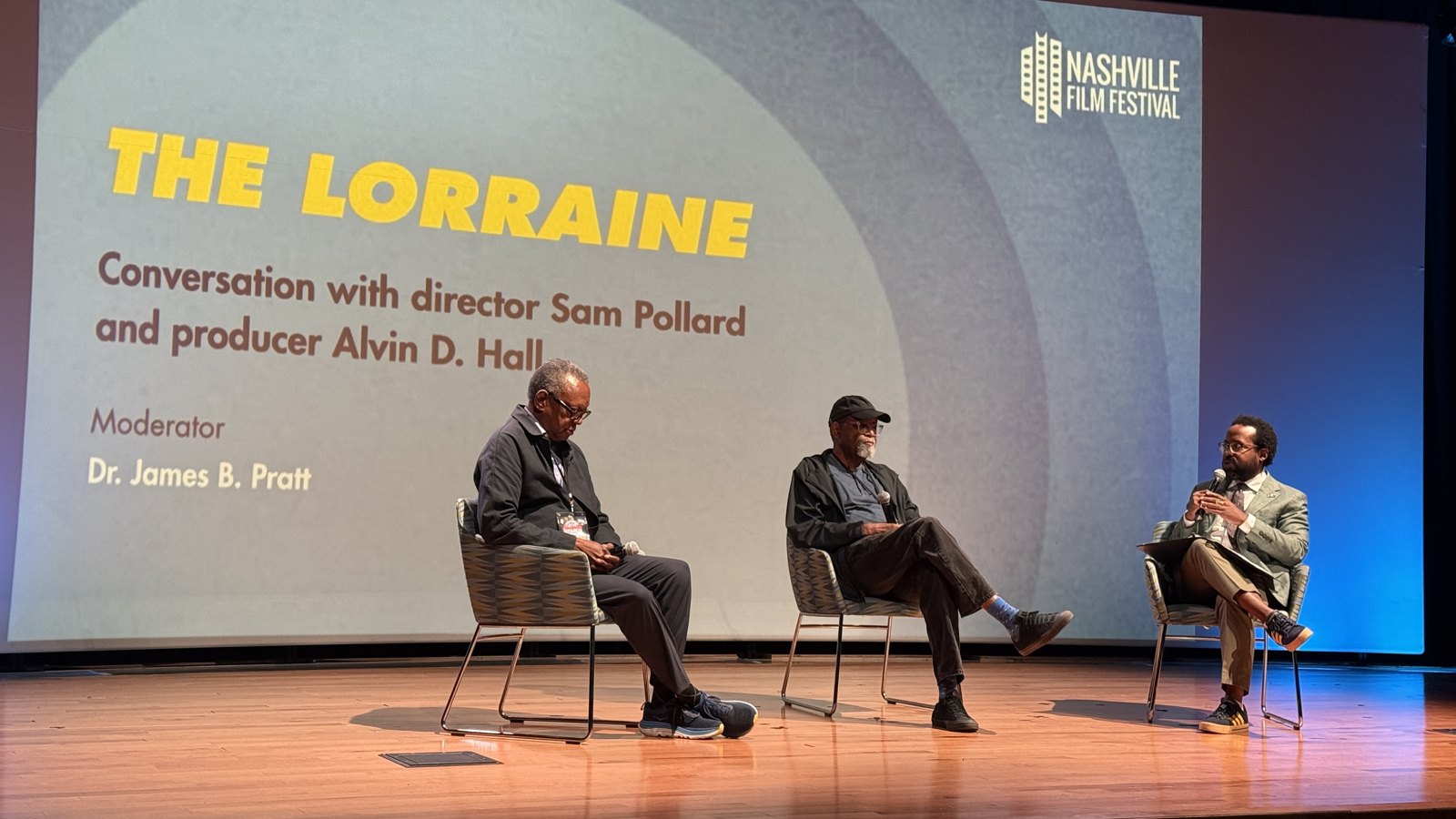
After the credits, Pollard and Hall sat down with moderator Dr. James B. Pratt Jr., and both men came ready, strong in their convictions. When the floor opened, I asked whether there was a story from the motel they loved that didn't survive the edit. Hall described archival footage of the Prairie View A&M a cappella chorus, students in their pajamas, singing to Dr. King in the motel's conference room. It had worked in an earlier BBC documentary of his, he said, but here it didn't move the story forward. Pollard's answer was simpler. "I have a rule," he said. "My rule is when the film is done, I have amnesia. I don't miss anything. No regrets."
Pollard is clearly a man that is stoic in his decisions and feelings on them. When he has created something he is done, the piece is done, and it was done well in his eyes. There is more art for him to create, more stories to tell, and dwelling on what could have been is clearly not something that will get in his way.
The film doesn't stay in the past, either. In its closing stretch, it brings in present-day politics, using the Lorraine's story to show that the fight it stood for is still going on today. Justin J. Pearson, the Memphis lawmaker whose 2023 expulsion from the Tennessee House made national news, makes an appearance. That choice moved me more than anything else in the film's final minutes. These are stories still unfolding, still blossoming in real time, and no one knows yet where they will end up. Putting them beside the Lorraine's history says the story isn't finished.
That's also where the one part that left me unsure comes in: the ending turns to Jacqueline Smith. After some research of my own, I understood. Smith was the Lorraine's last resident, carried out of her room by police when the motel was emptied in 1988 to make way for the National Civil Rights Museum, and she has protested outside it ever since. Her objection, as she told the BBC, isn't to remembering Dr. King. It's that the site dwells on his death instead of carrying on his work for the poor and for the people being pushed out of the neighborhood around it. Including her is the film's way of telling the whole story, even the part that belongs to people who feel the Lorraine was taken from them. As Hall put it during the conversation, telling the truth about the Lorraine means showing all of it.
The Lorraine is for anyone who wants to learn about the motel, about Black America, and about a piece of U.S. history that still stands. It is a culturally significant, timely film, and a must-watch for anyone trying to better understand the history of Tennessee, the Civil Rights Movement and Black America, especially from an outside lens like mine. Chase said the dream had been passed down to his generation. Pollard and Hall's film makes the same case about the place itself: history doesn't live in one day. It lives inside a home, and that home was, and in some ways still is, the Lorraine.
Fittingly, as I sat down to write about this piece of art, Purple Rain played over my head at a cafe in Nashville, a song about love and the end of the world. The Lorraine is much the same. A place filled with so much love. So much pain. In the end, a purple place in the west of Tennessee, in the still deep South of America. A place still at war between red and blue, with a hopeful day after purple rain.
Seen at the Nashville Film Festival, National Museum of African American Music, Saturday, September 26, 2026.
Follow the field coverage
Occasional dispatches when TVI is in the room: festival guides, interviews, and what we learned. No volume, no noise.
- First impressionWhere the Hell Is Anna? Knows How to Welcome You In
- First impressionSafe for the Whole Family Asks Who It Was Really Safe For
- First impressionLittle Hollywood, Tennessee: The People Who Help You Begin
- InterviewLittle Hollywood, Tennessee: A Runway to Fail
- First impressionMexican Delight: The Fear of Wanting
- InterviewTaylor Dupuis on Why Anna Wants to Stay
- First impressionYour Mother Your Mother Your Mother Finds Its Way Home
- First impressionFrampton: What Comes After the Peak
- Field dispatchThe Art of Saying Yes: John Papsidera at the Nashville Film Festival
- First impressionJackrabbit Knows the Value of a Good Liar
- First impressionThe Company You Keep: Seven Shorts from the Nashville Film Festival
- Field dispatchSongs from the Circle at the Nashville Film Festival
- The full festival guide